Choosing the right crane system is a key decision for any industrial facility. Whether upgrading a workshop or planning a new warehouse layout, understanding the differences between a Ceiling Mounted Bridge Crane and a floor-mounted crane directly impacts your operational efficiency, safety, and long-term cost.
This guide compares both systems in detail, highlights the core advantages of adopting a Ceiling Mounted Bridge Crane, presents ideal use cases, and explains the limitations you need to consider before purchase. The goal is to help international buyers make informed decisions and choose the most suitable overhead lifting solution for their specific applications.
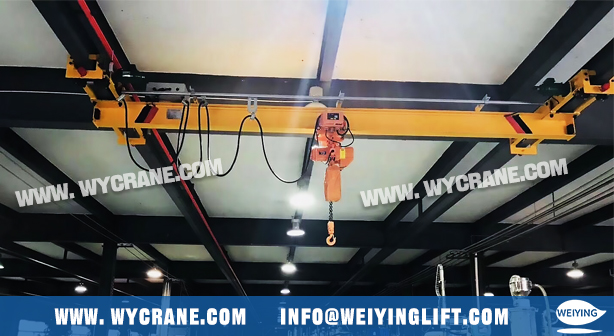
Although both crane types perform similar lifting functions, their design, installation method, and space utilization differ significantly. Understanding these differences is essential before selecting a crane.
A Ceiling Mounted Bridge Crane uses the building’s roof structure—such as beams, trusses, or steel rafters—to support the crane runway system. All lifting loads are transferred upward into the building structure.
In contrast, a floor-mounted crane (also called a freestanding crane) uses its own steel columns and support beams. The lifting load is transferred into the floor foundation, not into the building.
This makes ceiling-mounted systems ideal for facilities that need to maximize floor space.
Floor-mounted cranes are easier to install and can be relocated if production layout changes in the future.
A Ceiling Mounted Bridge Crane, however, becomes a permanent part of the building structure once installed.
The cost depends on building strength:
| Category | Ceiling Mounted Bridge Crane | Floor Mounted Crane |
| Floor Space | Fully open, no columns | Columns occupy floor |
| Building Requirements | Strong roof structure needed | Minimal |
| Flexibility | Permanent | Easier to relocate |
| Initial Cost | Lower if building is suitable | Higher steel cost |
| Installation | More complex | Simple and fast |
Many industries prefer a Ceiling Mounted Bridge Crane due to its long-term operational benefits. Below are the main advantages that make this system a top choice for modern manufacturing facilities.
This is the most significant advantage.
A Ceiling Mounted Bridge Crane eliminates the need for independent support columns, freeing valuable space for:
For factories struggling with tight layouts, this translates directly into improved productivity.
Ceiling-mounted systems can span the entire workshop, allowing:
This is ideal for assembly lines where products must pass through multiple manufacturing stages.
When the existing roof structure is strong enough, you avoid the expensive steel framework required for floor-mounted cranes. Over the crane’s lifetime, the savings can be substantial.
With no columns or floor obstacles, risks of:Forklift collisions,Worker injury,Equipment interferenceare greatly reduced. Operators can move loads safely above ground, maintaining a clean, hazard-free work environment.
Ceiling-mounted bridge cranes can be combined with:
This allows factories to design customized handling routes and achieve high workflow efficiency.
A Ceiling Mounted Bridge Crane is not suitable for every building, but it excels in specific industrial scenarios.
Industries like electronics, machining, welding, and packaging often operate in narrow spaces. A ceiling-mounted crane provides lifting coverage without sacrificing ground area.
For continuous processes such as:
a Ceiling Mounted Bridge Crane ensures smooth movement across all production zones.
Warehouses with tall racks benefit from overhead cranes because floor columns interfere with forklift or AGV operation. A ceiling-mounted crane moves loads across aisles without blocking traffic.
Industries with fixed workflows—such as injection molding, machining centers, or steel processing—benefit from a permanent ceiling-mounted solution that enhances lifting efficiency for years.
A CNC machining facility with dozens of machines in tight rows needs frequent movement of metal parts weighing 200–1500 kg. Installing a floor-mounted crane would obstruct machine layout and forklift paths.
A Ceiling Mounted Bridge Crane allows operators to lift materials directly from one machine to another, reducing manual handling, enhancing production speed, and maximizing usable space.
Although a Ceiling Mounted Bridge Crane has many benefits, it is not the ideal solution for every facility. Below are important factors you must evaluate.
The building must support:
If the roof structure is weak, reinforcement may be required, increasing installation cost.
Ceiling-mounted systems are permanent. Relocating or expanding them can be costly and time-consuming.
For industries that frequently restructure production layouts, a floor-mounted crane may offer better flexibility.
Before installation, engineers must conduct:
This ensures the crane operates safely and smoothly.
Ceiling-mounted cranes require specialized equipment for installation:
This increases the installation timeline.
Insufficient headroom reduces available lifting height.
If the lifting height requirement is high and the workshop ceiling is low, a floor-mounted crane or gantry crane may be a better choice.
When choosing between a Ceiling Mounted Bridge Crane and a floor-mounted crane, the following key factors should be carefully evaluated:
| Selection Factor | Ceiling Mounted Bridge Crane | Floor-Mounted Crane |
| Building Structure Condition | Ideal if the roof structure can support crane loads without reinforcement | Suitable when the building cannot bear additional load |
| Workflow Requirements | Best for open floor layouts and uninterrupted material flow | Better for operations requiring future layout flexibility |
| Equipment Footprint | Perfect for dense equipment layouts where floor space is limited | Suitable where floor space is less restricted |
| Lifting Capacity & Duty Level | Suitable for light to medium-duty applications | Preferred for heavy-duty and high-capacity lifting tasks |
| Budget & Long-Term Cost | Lower lifetime cost if no structural reinforcement is needed | Higher initial steel cost but avoids building modification expenses |
A Ceiling Mounted Bridge Crane is an excellent choice for facilities that value floor space, long travel distance, safety, and smooth integration with existing production lines. It is especially suitable for high-density workshops, assembly lines, and warehouses.
However, the building must have the structural strength to support the crane, and the permanent nature of the installation should be considered before purchase.
By evaluating your building conditions, workflow needs, load requirements, and long-term expansion plans, you can choose a crane system that delivers maximum value, safety, and operational efficiency.
>5 Ton Overhead Crane: A Comprehensive Guide to Choosing the Right Equipment
>How Many Slings Can Be Attached to a Crane Hook? A Complete Professional Guide
>The Guide to Overhead Crane Operator Safety Standards
>Workstation Bridge Crane: The Complete Guide for Buyers
A ceiling mounted bridge crane is an overhead lifting system installed directly on a building’s ceiling or roof beams, allowing material handling without occupying floor space.
No, the building must have sufficient structural strength to support the crane loads. Structural evaluation is required before installation.
A ceiling mounted bridge crane uses the building structure for support, while a freestanding crane relies on its own columns and does not depend on the building.

With 34 years of manufacturing experience and 12 years of export expertise, we have built a dual advantage of professional qualifications and a global presence. Our business covers more than 100 countries and regions across Asia, Europe, the Americas, Africa, and Oceania. We are certified under the ISO management system and hold CE product certifications. Our main product lines include six major series—electric hoists, electric winches, gantry cranes, bridge cranes, marine cranes, and portal cranes—comprising nearly 100 different models.
If you want to learn more, please contact us.
E-mail address: info@weiyinglift.com
Website: www.wycrane.com