Discover what a workstation bridge crane is, its key components, advantages, applications, and how to choose the right system for your facility. A complete buyer’s guide for modern material handling.
 |
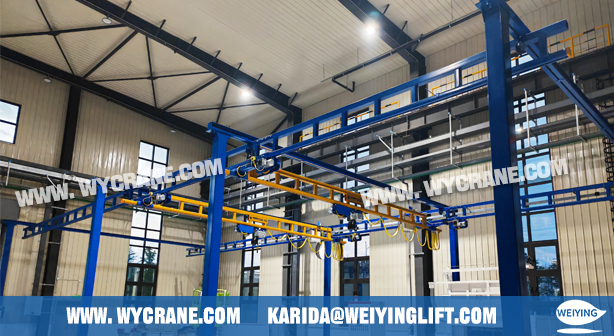 |
A workstation bridge crane is a modular, lightweight, and ergonomically designed lifting system engineered specifically for high-frequency, precision, and repetitive material handling in modern industrial environments. Compared with conventional overhead cranes—often heavier, more complex, and designed for large-scale lifting—workstation bridge cranes focus on efficiency, human-centered design, and workflow optimization.
In essence, this crane system bridges the gap between manual handling and heavy-duty lifting equipment. It allows operators to move loads quickly, safely, and with minimal physical effort, making it a critical tool in lean manufacturing, assembly lines, packaging plants, and advanced machining workshops.
The development of workstation cranes reflects a major shift in industrial production—from traditional brute-force lifting toward ergonomic automation, where reducing operator fatigue and improving process consistency are just as important as lifting capacity.
The support structure defines the crane’s layout flexibility.
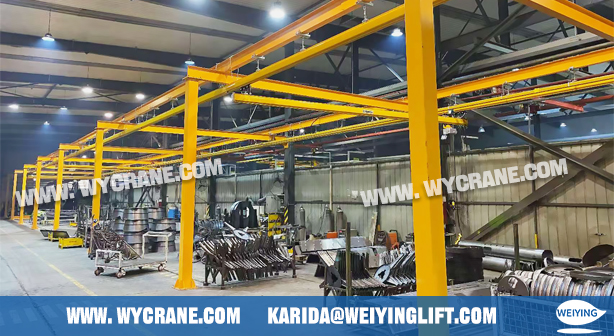
Freestanding systems allow installation without depending on building steel, perfect for older facilities, rented spaces, or areas where roof beams cannot support extra loads.
Ceiling-mounted systems eliminate floor obstructions, creating seamless travel paths across production lines.
This structural choice directly affects workflow design, operator walking distance, and material flow efficiency—all crucial for lean production.
The enclosed track is the heart of workstation bridge cranes. Its design features:
A smooth, enclosed profile that keeps dust out
Low rolling resistance (up to 30–40% lower than traditional I-beams)
Lightweight construction for effortless manual operation
This track design allows a worker to move a 500 kg load with only 1% of the force, making it dramatically more ergonomic and reducing long-term labor injuries.
The bridge beam spans between runway tracks. Its engineering goal is not just strength, but mass optimization:
Too heavy → increases operator fatigue
Too light → affects rigidity and stability
Well-designed bridges use finite element analysis (FEA) to ensure balance between stiffness and weight, maintaining precise load positioning.
Different applications require different hoists:
Electric chain hoists for everyday lifting
Air hoists for clean rooms, hazardous areas, or ultra-precise handling
Manual hoists for low-duty use or cost-sensitive tasks
A high-quality trolley minimizes resistance and prevents load swing, enhancing both safety and productivity.
Controls influence user experience:
Pendant controls → intuitive, cost-effective
Remote controls → safe distance operation, ideal for awkward load shapes
Smart controls → overload protection, anti-sway, speed adjustment
Advanced plants increasingly integrate hoists with PLC systems and MES, enabling data tracking and digital oversight.
Engineered for maximum flexibility, freestanding systems:
Work independently of building structure
Can be relocated as production layouts change
Support modular runway expansions
This makes them ideal for companies expecting future growth or restructuring.
This type is designed for efficiency and large-area coverage:
Zero floor obstruction
Long spans (often 6–12 m or more)
Excellent for continuous assembly processes
The limitation lies in building steel load capacity—detailed structural analysis is required to maintain safety.
Best suited for general production, offering:
Lighter structure
Lower cost
Fast, ergonomic manual operation
Its efficiency makes it dominant in electronics assembly, packaging lines, and light manufacturing.
When higher capacity or longer spans are required:
Double girders deliver improved rigidity
Less beam deflection
Compatibility with heavier hoists
They are common in machining workshops, aerospace assembly, and precision engineering.
Monorails are essentially point-to-point transport lines:
Move loads through fixed routes or curved paths
Integrate multiple workstations
Excellent for sequential assembly or logistical flow
They serve as the “arteries” of material transportation in specialized production.
These cranes reduce strain-related injuries by:
Minimizing force required to move loads
Allowing operators to work in neutral postures
Reducing repetitive motion stress
For companies, this translates directly to lower medical costs and fewer injury-related downtime incidents.
Studies show workstation cranes can reduce handling time by 25–40%.
Operators stay fresher longer, enabling:
Shorter cycle times
Faster changeovers
Higher daily output
This is especially valuable in labor-intensive sectors where efficiency directly parallels profitability.
Compared with overhead cranes:
Installation cost is 30–50% lower
No building reinforcement required (freestanding models)
Maintenance is simpler
This makes workstation systems ideal for small and medium-sized workshops needing professional lifting without heavy infrastructure investment.
The crane grows with your business:
Add more bridge cranes to a single runway
Extend track length
Add junctions, curves, and monorail branches
This capability protects your investment over the long term.
Ideal for:
Controlled assembly
Picking and placement
Mold or fixture handling
Delicate component transport
Operators can place loads within millimeter-level accuracy without wobble or swing.
Workstation bridge cranes thrive in industries where speed, accuracy, and operator comfort matter.
Engine blocks, frames, and gearbox assembly
Automotive bumper, seat, and dashboard handling
Modular manufacturing lines
Loading/unloading CNC, lathes, and milling machines
Handling molds, jigs, and precision fixtures
Clean room material handling
PCB assembly support
Equipment maintenance
Warehouse picking
Packing line loading
Pallet handling
Delicate component assembly
Titanium/steel part movement
Precision positioning of structural elements
Workstation cranes can work with:
AGVs
Robotic arms
Smart conveyors
This creates hybrid semi-automated production lines.
Inspect:
Column bases
Ceiling hangers
Beam alignment
Track joint integrity
Small misalignments can cause rolling resistance increases that impact performance and safety.
Never lift off-center loads
Ensure hooks are fully latched
Maintain stable lifting angles
Training should include:
Controlled walking speed
Safe positioning relative to the load
Avoiding manual force while the load is hanging
Crane systems should include:
Emergency stop buttons
Overload limiters
Thermal protection for electric hoists
These are critical for protecting both personnel and equipment.
If movement becomes difficult:
Check track cleanliness
Inspect trolley wheel wear
Check alignment of runway and bridge
Often a small adjustment restores factory-level smoothness.
Look for:
Chain elongation
Wear marks
Brake pad thickness
A failing brake is a major hazard and must be serviced immediately.
Check:
Pendant cable for cuts
Limit switch calibration
Festoon cords for tension or sagging
Over years of use:
Track ends, joints, and brackets can fatigue
Bolts may loosen due to vibration
Coating may wear, causing corrosion
Proactive maintenance can extend lifespan by 5–10 years.
Consider:
Peak load (not just average load)
Lifting frequency
Duty cycle
For example, a 500 kg load lifted once per hour is far different from the same load lifted every minute.
Questions to ask:
How far does the load need to travel?
Are multiple operators involved?
Does the crane need to feed multiple stations?
Layout design directly affects productivity.
Ceiling height
Column spacing
Floor load capacity
Interference from pipelines or HVAC
These factors determine whether to choose freestanding or ceiling-mounted.
Aluminum: best for manual pushing, clean rooms
Steel: best for longer spans and higher loads
For example:
Electronics industry often chooses air hoists
General manufacturing uses electric chain hoists
Occasional lifting chooses manual hoists
Choose a system you can modify later:
Extend runways
Add bridges
Add monorails
Integrate automation
This protects long-term investment.
A workstation bridge crane is not just a lifting device—it is an industrial productivity tool, an ergonomic optimization system, and a core component of modern lean manufacturing. Its modularity, precision, flexibility, and cost advantages make it essential for factories seeking to improve workflow efficiency and reduce operator fatigue.
Understanding its components, engineering logic, safety standards, and selection criteria ensures you can make a long-term, value-driven investment that supports your production growth for years to come.
Workstation cranes focus on light-to-medium loads, ergonomics, and efficiency, whereas overhead cranes focus on heavy-duty lifting.
Typically 125 kg to 2000 kg, but custom models can reach higher capacities.
Yes. Bridges, trolleys, and hoists can be fully motorized depending on workflow needs.

With 34 years of manufacturing experience and 12 years of export expertise, we have built a dual advantage of professional qualifications and a global presence. Our business covers more than 100 countries and regions across Asia, Europe, the Americas, Africa, and Oceania. We are certified under the ISO management system and hold CE product certifications. Our main product lines include six major series—electric hoists, electric winches, gantry cranes, bridge cranes, marine cranes, and portal cranes—comprising nearly 100 different models.
If you want to learn more, please contact us.
E-mail address: karida@weiyinglift.com
Website: www.wycrane.com