A 10 ton gantry crane is a widely used medium-duty industrial lifting solution designed for handling heavy materials in factories, warehouses, construction sites, steel yards, and manufacturing facilities.
With a lifting capacity of 10 tons (10,000 kg), this type of crane provides a balance between lifting performance, structural strength, and investment cost. Compared with smaller 5 ton gantry cranes, a 10 ton model can handle heavier machinery, steel components, and industrial equipment while maintaining flexible installation options.
Depending on different operating requirements, a 10 ton gantry crane can be designed as a single girder gantry crane, double girder gantry crane, or customized industrial gantry crane.
This guide explains the main types, specifications, applications, price factors, selection tips, and practical considerations before purchasing a 10 ton gantry crane.
A 10 ton gantry crane is a freestanding lifting machine capable of lifting and transporting loads up to 10 metric tons.
Unlike overhead cranes that require runway beams installed on the building structure, gantry cranes are supported by their own legs and travel systems. This makes them suitable for both indoor and outdoor lifting operations.
A typical 10 ton gantry crane consists of:
During operation:
This three-directional movement allows operators to efficiently handle heavy loads across a working area.
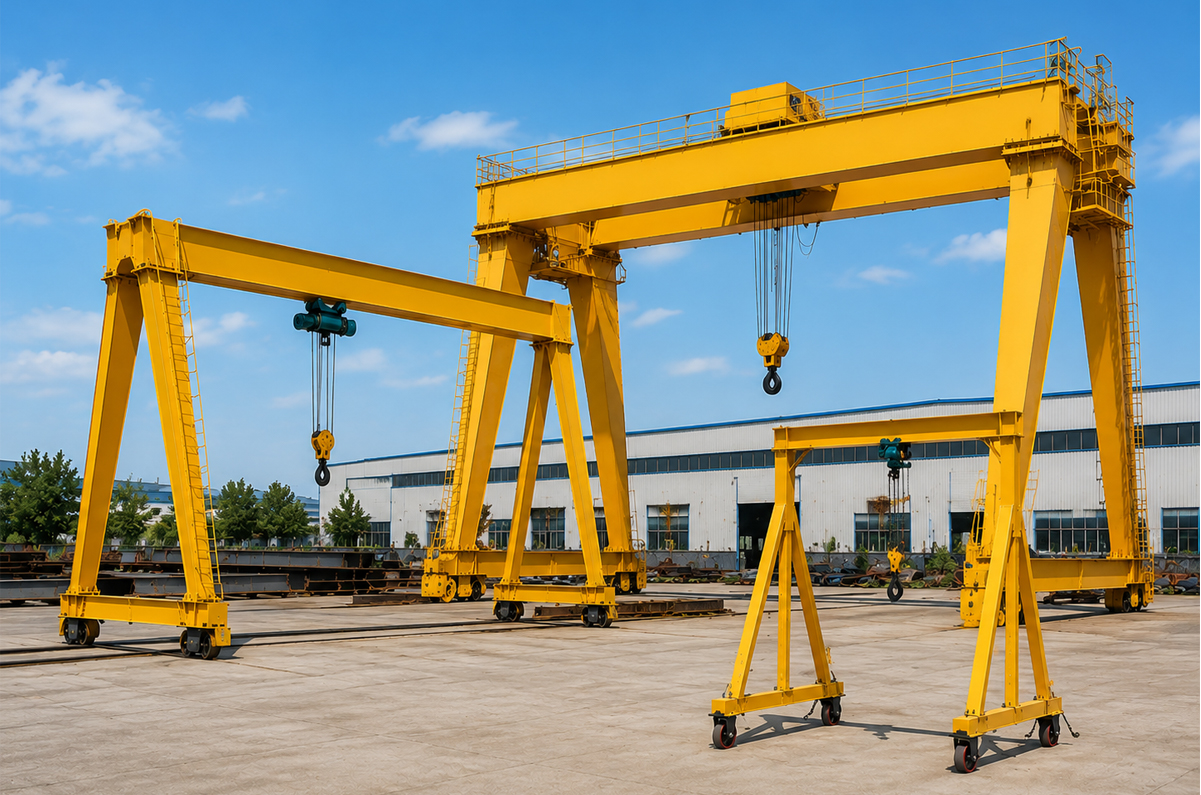
Different industries have different requirements for lifting height, working frequency, and operating conditions. The main types of 10 ton gantry cranes include:
A single girder gantry crane uses one main beam supported by two legs. It is a cost-effective solution for medium-duty lifting applications.
Compared with double girder models, single girder cranes require less material and have lower manufacturing costs.
The lightweight structure reduces transportation and installation difficulties.
It can efficiently handle common industrial lifting tasks.
A single girder 10 ton gantry crane is suitable for companies requiring reliable lifting performance while controlling the initial investment.
A double girder gantry crane uses two parallel main beams, providing higher strength and stability.
It is designed for heavy-duty industrial applications requiring frequent lifting operations.
The double girder structure provides better resistance against deformation when handling heavy loads.
The hoist can be positioned higher, providing better hook clearance.
It performs better under:
For factories operating cranes every day, a double girder gantry crane usually provides better long-term value.
A portable gantry crane is designed for flexible lifting operations where crane relocation is required.
Compared with fixed industrial gantry cranes, portable models usually use wheels or modular structures.
Portable gantry cranes are often used for equipment maintenance, workshops, and temporary lifting tasks.
The specifications of a 10 ton gantry crane depend on the crane structure, working environment, and customer requirements.
Typical specifications include:
| Parameter | Specification |
| Lifting Capacity | 10 Ton |
| Crane Type | Single Girder / Double Girder |
| Span | 10 m – 35 m |
| Lifting Height | 6 m – 12 m |
| Working Class | A3 – A5 |
| Lifting Speed | 0.8 – 8 m/min |
| Traveling Speed | 10 – 30 m/min |
| Control Method | Pendant Control / Remote Control |
| Power Supply | 380V 50Hz Three Phase |
| Working Temperature | -20℃ to +40℃ |
Specifications can be customized according to:
A 10 ton gantry crane is widely used in industries requiring medium-heavy lifting capacity.
A gantry crane for workshop applications is commonly used for:
Steel industries use 10 ton gantry cranes for:
Applications include:
Used for:
Portable and mobile configurations can be used for:
One of the most common questions from buyers is:
How much does a 10 ton gantry crane cost?
The price depends on crane design, specifications, and customization.
| Type | Estimated Price |
| Single Girder 10 Ton Gantry Crane | $15,000 – $35,000 |
| Double Girder 10 Ton Gantry Crane | $25,000 – $60,000 |
| Portable 10 Ton Gantry Crane | $8,000 – $25,000 |
The final 10 ton gantry crane price depends on:
Double girder cranes require more steel and stronger components, resulting in higher costs.
Larger dimensions increase:
A crane designed for frequent operation requires higher-quality components.
For example:
Different hoists affect cost:
Optional upgrades include:
Selecting the correct crane requires evaluating your actual working requirements.
Consider:
A 10 ton crane should not operate continuously at its maximum rated capacity.
The crane span should match:
Consider:
Outdoor applications may require:
Choosing a crane with additional capacity margin can reduce future replacement costs.
A steel fabrication company in Southeast Asia required a lifting system for moving structural steel components and welding assemblies.
The customer requirements were:
A customized 10 ton double girder gantry crane was supplied with:
After installation:
The customer selected a double girder design because the crane needed to operate frequently under industrial working conditions.
Proper installation directly affects crane safety and service life.
Check:
Important steps include:
Before operation:
The crane must always operate within its rated capacity.
Loads should remain vertically aligned with the hoist.
Check:
Operators should understand:
A 10 ton gantry crane is an efficient and reliable lifting solution for manufacturing plants, steel industries, warehouses, and construction projects.
Choosing between a single girder gantry crane, double girder gantry crane, or portable gantry crane depends on your lifting requirements, working frequency, environment, and budget.
Before purchasing a 10 ton gantry crane, carefully evaluate the required span, lifting height, duty class, safety features, and future expansion plans.
A properly selected industrial gantry crane can improve productivity, reduce labor costs, enhance workplace safety, and provide reliable service for many years.
The best choice depends on the working conditions.
Yes, a portable gantry crane can be designed for 10 ton lifting capacity, but its structure, span, and mobility must be carefully engineered.
Compared with fixed industrial gantry cranes, portable models usually have limitations in lifting height, span length, and continuous heavy-duty operation. They are more suitable for flexible lifting tasks, maintenance work, and temporary applications.
The main factors affecting 10 ton gantry crane price include:
Customized configurations and special working conditions will increase the overall gantry crane cost.

With 34 years of manufacturing experience and 12 years of export expertise, we have built a dual advantage of professional qualifications and a global presence. Our business covers more than 100 countries and regions across Asia, Europe, the Americas, Africa, and Oceania. We are certified under the ISO management system and hold CE product certifications. Our main product lines include six major series—electric hoists, electric winches, gantry cranes, bridge cranes, marine cranes, and portal cranes—comprising nearly 100 different models.
If you want to learn more, please contact us.
E-mail address: info@weiyinglift.com
Website: www.wycrane.com