Outdoor gantry cranes are widely used in ports, shipyards, construction sites, steel yards, logistics centers, and manufacturing plants. Unlike indoor overhead cranes, they are directly exposed to weather conditions, making wind load an important factor in crane design, stability, and safe operation.
Strong winds can act on the crane structure, rails, electrical equipment, lifting accessories, and suspended loads. For large outdoor gantry cranes, especially those installed in coastal or high-wind areas, proper wind-load assessment and storm protection should be considered from the beginning of the project.
This guide explains how wind affects gantry cranes, the major standards used for wind-load and crane safety requirements, and the key factors to consider when selecting a gantry crane for a high-wind environment.
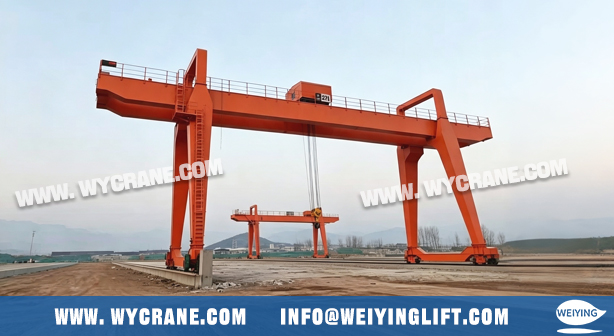
Wind is one of the important environmental loads that should be considered when designing an outdoor gantry crane.
A gantry crane may have a large steel structure with considerable height and wind-exposed area. During strong winds, horizontal forces can act on:
The effect becomes more significant as crane height and exposed area increase.
A simple way to understand the relationship is that wind pressure increases approximately with the square of wind speed. Therefore, a substantial increase in wind speed can produce a much larger increase in wind pressure.
For example, doubling the wind speed can theoretically increase the velocity-related pressure term by about four times, assuming other conditions remain unchanged.
For this reason, wind should not be treated as a minor consideration when designing an outdoor gantry crane.
The influence of wind depends on much more than the crane’s rated lifting capacity. Crane dimensions, structure, load size, operating condition, and local wind conditions all play a role.
Higher wind speeds create greater horizontal forces on the crane. The design wind condition should therefore be determined according to the installation location and applicable design standards.
The actual wind-load calculation may consider factors such as wind speed, exposed area, aerodynamic characteristics, and the height of the structure.
A tall gantry crane generally presents a larger area to the wind. A wide or highly enclosed structure can also experience significant wind forces.
For this reason, two cranes with the same lifting capacity may have very different wind-load requirements.
For example, a 10-ton gantry crane with a short span and low height may have substantially different wind exposure from a 10-ton crane with a long span and high legs.
The suspended load can also become an important source of wind exposure.
Large loads such as:
may have considerable projected areas.
Strong wind can cause the suspended load to swing, creating additional dynamic effects and making precise positioning more difficult.
Gantry crane wind conditions are commonly considered in two basic states:
| Condition | Typical Situation | Main Concern |
| In-service | Crane is lifting or traveling | Wind combined with lifting and operating loads |
| Out-of-service | Crane is parked | Strong wind, unintended movement and stability |
Both conditions are important.
ISO 4302:2016 specifically provides methods for assessing crane wind loads in in-service and out-of-service conditions and also provides guidance on when a crane should be secured for out-of-service conditions.
No. There is no single wind speed that applies to every gantry crane.
The allowable wind condition depends on factors including:
Therefore, the wind-speed limit of one gantry crane should not automatically be applied to another crane.
The manufacturer’s technical documentation and the requirements of the specific project should always be followed.
Different countries and projects may use different standards. The applicable requirements should be determined according to the destination market, local regulations, project specifications, and contract requirements.
| Standard | Main Focus |
| ISO 4302 | Wind load assessment for cranes |
| ISO 8686-1 | Loads and load combinations |
| EN 13001-2 | Crane load actions and load combinations |
| EN 15011 | Safety requirements for bridge and gantry cranes |
| ASME B30.2 | Construction, installation, operation, inspection and maintenance of applicable overhead and gantry cranes |
| GB/T 3811 | Crane design rules in China |
ISO 4302:2016 is particularly relevant to gantry crane wind load because it addresses wind-load assessment for cranes under both in-service and out-of-service conditions. ISO states that the 2016 edition was reviewed and confirmed in 2023 and remains current, while ISO/DIS 4302 is under development as a revision.
EN 13001-2:2021 addresses load actions and load combinations used to determine load effects for crane and component design. This is important because wind should generally be considered as part of the appropriate design load combinations rather than evaluated in isolation.
EN 15011:2020 specifically covers bridge and gantry cranes and addresses significant hazards and safety requirements, including areas related to strength and stability.
ASME B30.2-2022 applies to specified top-running overhead and gantry cranes and covers construction, installation, operation, inspection, and maintenance.
GB/T 3811-2008, Design rules for cranes, is listed as a current Chinese national standard by China’s national standards platform.
The important point is that these standards do not all serve exactly the same purpose. A project may require several standards to be considered together.
Good wind resistance is not achieved simply by making the steel structure heavier. A complete solution should consider the crane structure, running system, parking arrangement, and storm protection equipment.
The main girder, legs, end trucks, connections, and other structural components should be designed and verified according to the applicable load conditions.
Important design factors include:
For rail-mounted gantry cranes, the running system is an important part of overall stability.
The design should consider:
Poor rail installation or inadequate braking can increase the risk of unintended crane movement during strong winds.
Outdoor gantry cranes may require dedicated storm protection systems, depending on their design and site conditions.
Possible solutions include:
These devices help secure the crane when it is not operating.
For large outdoor gantry cranes, an anemometer or wind-speed monitoring system can provide real-time information about site conditions.
A warning system can help operators identify increasing wind conditions and take action according to the crane’s operating procedures.
The alarm and shutdown thresholds should be determined by the crane design, manufacturer’s instructions, applicable standards, and site safety procedures rather than using a universal value.
When strong winds or severe weather are expected, the crane should be moved to its designated safe parking position and secured according to the manufacturer’s instructions.
A typical procedure may include:
Stop lifting → Move to designated parking position → Secure the crane → Apply storm protection → Follow site emergency procedures
The exact procedure depends on the crane design and project requirements.
Different gantry crane configurations can have different wind characteristics, but crane type alone does not determine wind resistance.
| Gantry Crane Type | Main Wind Consideration |
| Single Girder Gantry Crane | Generally smaller structural mass and exposed area |
| Double Girder Gantry Crane | Larger structure may create greater wind exposure |
| Portable Gantry Crane | Mobility makes safe positioning and securing particularly important |
| Rubber-Tired Gantry Crane | Parking, braking and stability require careful consideration |
| Rail-Mounted Gantry Crane | Rail clamps, brakes and storm anchoring may be important |
A double girder crane is not automatically more wind-resistant than a single girder crane, and a heavier crane is not automatically safer in strong winds.
The actual design must be evaluated based on the complete set of structural and environmental conditions.
If you are purchasing an outdoor gantry crane for a high-wind or coastal area, provide the manufacturer with as much site information as possible before the crane is designed.
1. Local wind conditions
Provide the applicable basic or design wind speed for the installation location.
2. Crane span and height
These directly affect the structural configuration and wind-exposed area.
3. Load dimensions
Do not provide only the lifting capacity. Large loads may have significant wind-exposed areas.
4. In-service wind condition
Confirm the wind conditions under which normal crane operation is permitted.
5. Out-of-service wind condition
Determine the wind condition the parked crane needs to withstand and how it will be secured.
6. Storm protection system
Determine whether rail clamps, storm locks, anchors, or other devices are required.
7. Applicable standards
Confirm whether the project requires ISO, EN, ASME, GB/T, or specific local regulations.
A useful selection process is:
Site wind conditions → Crane dimensions → Load characteristics → Design loads → Applicable standards → Storm protection → Final crane design
This approach is more reliable than selecting a crane based only on lifting capacity.
Wind load is an important design and safety consideration for outdoor gantry cranes, particularly in coastal areas, ports, shipyards, and other locations exposed to severe weather.
The key is to understand that gantry crane wind resistance is not determined by one specification. It depends on the interaction of:
Crane structure + wind load + load dimensions + running system + braking + storm protection + local environment
Standards such as ISO 4302, EN 13001-2, EN 15011, ASME B30.2, and GB/T 3811 provide important frameworks for crane design and safety, but the applicable requirements depend on the specific project and market.
For a high-wind gantry crane project, the most important step is to provide the manufacturer with the installation location, lifting capacity, span, lifting height, load dimensions, working conditions, and local wind information at the beginning of the design process.
Wind load is the force generated by wind acting on the crane structure, equipment, and, where applicable, the suspended load. It is an important consideration for outdoor gantry crane design and stability.
There is no universal wind-speed limit for all gantry cranes. The allowable wind condition depends on the crane design, operating state, site conditions, and applicable standards.
Outdoor gantry cranes may require wind protection systems such as rail clamps, storm locks, brakes, or anchoring devices, particularly where strong winds are expected.
In-service wind load applies while the crane is operating, whereas out-of-service wind load applies when the crane is parked. Both conditions may need to be considered during design.
Coastal gantry cranes can experience greater exposure to strong winds and severe weather. They may also require additional corrosion protection because of salt spray and humid environments.
ISO 4302 is specifically concerned with wind-load assessment for cranes and covers both in-service and out-of-service conditions.
No. A crane’s lifting capacity is only one design parameter. Height, span, structure, wind-exposed area, load dimensions, and local wind conditions can also significantly affect wind resistance.

With 34 years of manufacturing experience and 12 years of export expertise, we have built a dual advantage of professional qualifications and a global presence. Our business covers more than 100 countries and regions across Asia, Europe, the Americas, Africa, and Oceania. We are certified under the ISO management system and hold CE product certifications. Our main product lines include six major series—electric hoists, electric winches, gantry cranes, bridge cranes, marine cranes, and portal cranes—comprising nearly 100 different models.
If you want to learn more, please contact us.
E-mail address: info@weiyinglift.com
Website: www.wycrane.com