Bridge Crane vs Gantry Crane: A Complete Comparison Guide
Date:2026-07-29 View:162
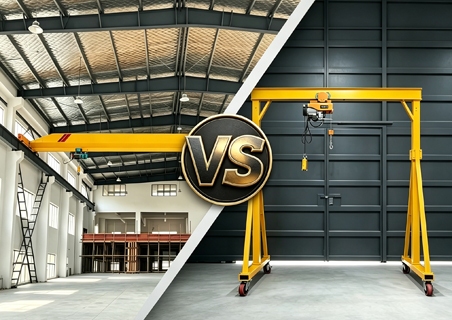
When selecting lifting equipment for a factory, warehouse, workshop, or outdoor industrial site, two of the most commonly considered solutions are bridge cranes and gantry cranes. Both cranes use a bridge structure and a hoisting mechanism to move heavy loads horizontally and vertically. They are widely used in manufacturing, steel processing, logistics, shipyards, and material handling industries. However, despite their similar lifting functions, bridge cranes and gantry cranes have important differences in structure, installation method, working environment, cost, and application scenarios. This article explains the differences between bridge cranes and gantry cranes, applications, and how to select the right crane for your project. What Is a Bridge Crane? A bridge crane, also known as an overhead bridge crane, is a fixed lifting system commonly installed inside factories, workshops, warehouses, and other permanent industrial buildings. Its bridge girder travels along elevated runway beams, while the hoist or trolley moves across the bridge. This allows the crane to cover a large rectangular working area without occupying much floor space. Bridge cranes are available in single girder and double girder configurations. Single girder cranes are commonly used for light- and medium-duty applications, while double girder cranes are better suited to heavier loads,...