When selecting lifting equipment for a factory, warehouse, workshop, or outdoor industrial site, two of the most commonly considered solutions are bridge cranes and gantry cranes.
Both cranes use a bridge structure and a hoisting mechanism to move heavy loads horizontally and vertically. They are widely used in manufacturing, steel processing, logistics, shipyards, and material handling industries.
However, despite their similar lifting functions, bridge cranes and gantry cranes have important differences in structure, installation method, working environment, cost, and application scenarios.
This article explains the differences between bridge cranes and gantry cranes, applications, and how to select the right crane for your project.
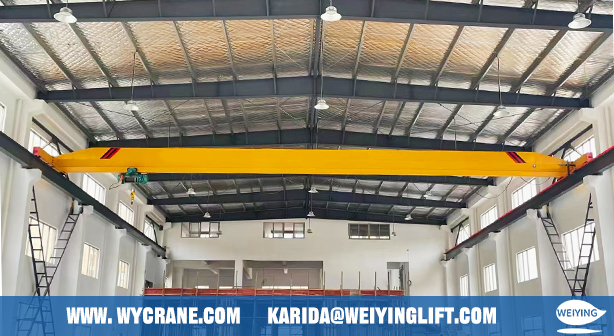
A bridge crane, also known as an overhead bridge crane, is a fixed lifting system commonly installed inside factories, workshops, warehouses, and other permanent industrial buildings.
Its bridge girder travels along elevated runway beams, while the hoist or trolley moves across the bridge. This allows the crane to cover a large rectangular working area without occupying much floor space.
Bridge cranes are available in single girder and double girder configurations. Single girder cranes are commonly used for light- and medium-duty applications, while double girder cranes are better suited to heavier loads, larger spans, higher lifting heights, and demanding working conditions.
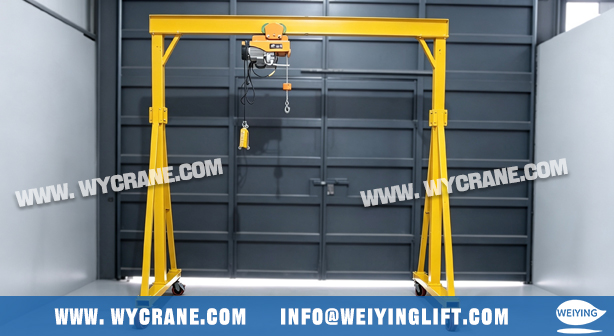
A gantry crane is a crane whose bridge girder is supported by independent legs. The legs transfer the crane load to the ground through wheels or rail-mounted traveling mechanisms.
Because it does not normally depend on the building structure, a gantry crane can be installed in open areas where an overhead runway is unavailable.
Typical applications include steel yards, precast concrete plants, shipyards, ports, railway facilities, construction sites, and outdoor material storage areas.
Gantry cranes are also available in single girder and double girder designs, while smaller mobile gantry cranes can provide additional flexibility for different working locations.
The following table summarizes the main differences between the two crane types:
|
Feature |
Bridge Crane |
Gantry Crane |
|
Main support |
Elevated runway structure |
Independent supporting legs |
|
Load transfer |
Building or runway structure |
Ground through legs and wheels |
|
Typical environment |
Mainly indoor |
Indoor or outdoor |
|
Building requirement |
Requires suitable runway support |
Does not depend on building structure |
|
Floor space |
Minimal obstruction on the floor |
Legs and rails occupy working space |
|
Installation flexibility |
More dependent on existing building |
More flexible |
|
Relocation |
Generally difficult |
Some designs can be relocated |
|
Typical applications |
Factories, workshops, warehouses |
Steel yards, ports, shipyards, construction sites |
|
Main advantage |
Efficient use of indoor space |
Flexible installation and outdoor operation |
The table provides the basic technical distinction. In practice, however, the best choice depends mainly on where the crane will operate and how the lifting area is organized.
Choosing the correct crane depends on your working conditions.
A bridge crane is usually the better choice when:
✔ You have an existing factory building
✔ The crane will operate indoors
✔ Floor space is limited
✔ You need frequent lifting operations
✔ You want maximum use of workshop space
Example:
A manufacturing plant moving steel parts every day would usually benefit from an overhead bridge crane.
A gantry crane is usually better when:
✔ Outdoor operation is required
✔ No suitable building structure exists
✔ Flexible installation is needed
✔ The crane may need relocation
✔ Heavy materials are handled in open areas
Example:
A steel storage yard requiring outdoor lifting would typically choose a gantry crane.
Regardless of crane type, proper inspection and maintenance are essential for safe operation. Gantry cranes operating outdoors require additional attention because their rails, electrical systems, and steel structures are exposed to weather conditions.
Regularly check the hook, wire rope, drum, brakes, wheels, gearbox, and other important mechanical components. Look for abnormal wear, deformation, cracks, unusual noise, or vibration.
For rail-mounted gantry cranes, rail alignment, wheel condition, rail connections, and foundation settlement should be checked regularly. Problems with the traveling system can cause abnormal wheel loading and affect crane stability.
Outdoor gantry cranes should be designed and operated according to the applicable wind requirements. Wind protection devices such as rail clamps or storm locks may be required depending on the crane design and local conditions.
Regularly verify the operation of:Limit switches,Overload protection,Emergency stops,Warning alarms,Travel limit devices,Control systems
The crane, hoist, hook, slings, shackles, and other lifting accessories must be suitable for the load. Operators should never exceed the rated capacity or use damaged lifting equipment.
Workers should not stand or work directly underneath suspended loads. Operators should lift smoothly, maintain clear communication, and make sure the travel path is clear before moving the load.
Both bridge cranes and gantry cranes are reliable industrial lifting solutions, but they are designed for different environments.
A bridge crane is ideal for factories, workshops, and warehouses where overhead runway structures are available. It provides excellent space utilization and efficient indoor material handling.
A gantry crane is better for outdoor applications, open yards, and locations without suitable building support structures. Its independent design provides greater installation flexibility.
When choosing between a bridge crane and a gantry crane, consider:
Selecting the right crane type not only improves productivity but also ensures safer and more cost-effective lifting operations.
The main difference is the support structure. A bridge crane runs on elevated runway beams supported by a building, while a gantry crane uses independent legs supported by ground rails.
In many cases, gantry cranes have lower installation requirements because they do not need building modifications. However, the final cost depends on capacity, span, height, and configuration.
Gantry cranes are usually better for outdoor lifting because they have independent structures and better adaptability to open environments.

With 34 years of manufacturing experience and 12 years of export expertise, we have built a dual advantage of professional qualifications and a global presence. Our business covers more than 100 countries and regions across Asia, Europe, the Americas, Africa, and Oceania. We are certified under the ISO management system and hold CE product certifications. Our main product lines include six major series—electric hoists, electric winches, gantry cranes, bridge cranes, marine cranes, and portal cranes—comprising nearly 100 different models.
If you want to learn more, please contact us.
E-mail address: info@weiyinglift.com
Website: www.wycrane.com