Investing in a
jib crane can transform material handling efficiency, but the first question every buyer asks is straightforward:
How much does a jib crane cost? The honest answer is that prices vary widely. That gap exists because cost is driven by structural type, load capacity, boom length, hoist configuration, and installation complexity—not just the steel frame itself.
This guide breaks down real-world price ranges, explains what drives those numbers, and shows you how to match the right crane type to your application for maximum value.
Jib Crane Price Ranges by Type
The fastest way to estimate your budget is to identify which of the four main configurations fits your workflow.
| Type |
Typical Price Range |
Best For |
| Wall Mounted Jib Crane |
$950 – $4,000 |
Space-limited workshops, assembly stations |
| Mobile Jib Crane |
$2,000 – $9,000 |
Temporary or multi-station use |
| Pillar Jib Crane |
$5,000 – $20,000 |
Permanent heavy-duty fixed workstations |
| Wall Travelling Jib Crane |
$6,000 – $30,000 |
Long bays, automotive lines, large warehouses |
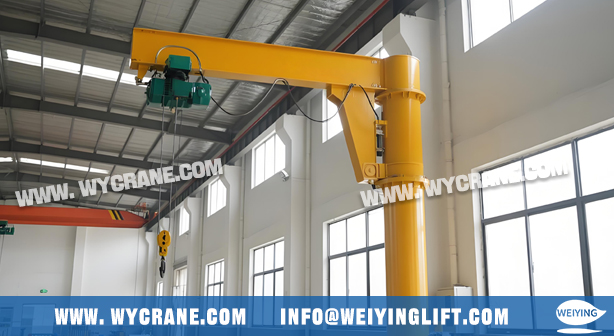
Wall mounted jib cranes generally offer the lowest entry cost because they eliminate the need for an independent foundation—they bolt directly to existing columns or walls. Mobile jib cranes add value through portability, using a counterweighted base instead of concrete. Pillar (floor-mounted) jib cranes command higher prices due to their self-supporting column, heavy-duty slewing bearing, and 360-degree coverage. At the top of the market, wall travelling jib cranes incorporate a runway track, travel motors, and advanced electrical systems, making them the most expensive per unit.
Key Factors That Drive Jib Crane Cost
Load Capacity
Capacity is the most obvious price driver. A 0.25-ton light-duty workstation crane uses smaller structural tubing, a lighter slewing ring, and a compact manual hoist. Step up to 3 tons, and the column diameter, wall thickness, base plate dimensions, and foundation requirements all increase proportionally. At 5 tons and above, manufacturers must engineer for fatigue resistance and stricter safety factors, which pushes material and machining costs significantly higher.
Boom Length and Working Radius
Standard boom lengths of 3 m, 4 m, or 5 m are produced in higher volumes, keeping prices competitive. Once you move into custom 6 m to 8 m+ spans, the arm must resist greater bending moments. Manufacturers often switch from standard pipe booms to box-section fabricated arms, add internal gussets, or specify larger-capacity slewing bearings to control deflection. If your application demands an extra-long reach, expect a 20–40% premium over standard lengths.
Hoist and Control Systems
The hoist often represents 25–40% of the total system cost.
- Manual chain hoists are the most economical but limit productivity.
- Electric wire rope hoists are the industry standard for speeds up to 8–16 m/min and integrate easily with pendant controls.
- Pneumatic hoists or explosion-proof electric hoists are required in hazardous environments and carry a substantial premium due to specialized motors and certifications.
Control upgrades also add cost. A basic push-button pendant is usually included, but switching to wireless remote control or variable frequency drive (VFD) for smooth acceleration adds $500–$2,500 depending on the system.
Installation and Foundation Work
This is where many budgets are underestimated. A pillar jib crane requires a dedicated concrete foundation engineered to resist overturning moments. Wall mounted jib cranes avoid foundation costs but may require structural reinforcement of the existing wall or column. Wall travelling systems need a precision-aligned runway track installed along the building frame. Always clarify whether your quote includes installation, supervision, or only supply.
Customization and Accessories
Standard painted carbon steel suits most indoor factories. However, special environments demand upgrades:
- Hot-dip galvanizing for outdoor or coastal applications
- Stainless steel construction for food, pharmaceutical, or cleanroom use
- Motorized slewing drives instead of manual rotation
- Rotation stops, overload limiters, load scales, or collision avoidance sensors
Each add-on is functional, but they compound quickly. A fully customized stainless steel pillar crane with motorized slew and a branded European hoist can cost double a standard carbon-steel equivalent.
Certification and Compliance
Equipment destined for the EU typically requires CE marking and compliance with the Machinery Directive. North American buyers may need ASME B30 or CMAA alignment. Explosion-proof applications require ATEX/IECEx certification. Obtaining and maintaining these certifications involves design audits, testing, and documentation—costs that are embedded in the final price but essential for legal operation and insurance coverage.
Budget Planning: Equipment vs. Total Cost of Ownership
When planning your budget, separate the equipment price from the landed project cost.
A realistic split looks like this:
- ~70%Equipment (crane, hoist, controls)
- ~5%Shipping, insurance, and import duties
- ~15%Foundation, installation, and electrical
- ~10%Commissioning, load testing, and inspection
To get an accurate quote, provide suppliers with a complete specification sheet: type, capacity, boom length, lifting height, duty class (e.g., FEM 2m or A5), environment (indoor/outdoor, temperature, explosive atmosphere?), and required certifications. Request an itemized bill of materials so you can compare apples to apples—especially the hoist brand, steel grades, and slewing bearing manufacturer.
Watch for common quoting traps: a “bare” crane price that excludes the hoist, a lower-capacity electric trolley substituted to cut costs, or a shortened warranty period that shifts risk back to you.
Which Type Offers the Best Value?
Value is not about the lowest sticker price; it is about solving your handling problem at the lowest total cost over the equipment life.
- For heavy, fixed workstations (2 t–10 t): The pillar jib crane is usually the best value. It is the most standardized design, which means competitive pricing, widely available spare parts, and straightforward maintenance.
- For flexible, temporary, or shared use (≤2 t): The mobile jib crane wins. You avoid all foundation work and can redeploy it as your floor layout changes.
- For space-constrained assembly or repair bays (≤3 t): The wall mounted jib crane delivers the lowest overall project cost by leveraging existing building structure and freeing up floor space.
- For long, linear work areas (automotive, warehousing): The wall travelling jib crane is expensive upfront but replaces multiple fixed cranes, reducing total capital expenditure across the bay.
- For hygienic or hazardous environments: Specialized stainless steel or explosion-proof wall mounted/pillar models are worth the premium because non-compliance carries far higher long-term costs.
Conclusion
So, how much does a jib crane cost? For most buyers, the practical range falls between $5,000 and $30,000 once you account for the crane, hoist, and standard installation. Wall-mounted and mobile units keep costs down for lighter duties, while pillar and wall travelling systems justify their price through durability and coverage.
The key to getting the best value is to match the crane type precisely to your application, demand an itemized quote, and budget for the foundation and commissioning work that follows the delivery. Start with a clear technical specification, compare total lifecycle costs rather than headline prices, and prioritize suppliers who back their equipment with robust documentation and after-sales support.
The right jib crane is the one matched to your application—not the cheapest headline price.
Compare total lifecycle costs, demand an itemized quote, and verify what the price includes before you buy.
FAQ
Q1: What is the cheapest type of jib crane?
A: The wall mounted jib crane is generally the most affordable, with prices starting around $2,000. It requires no independent concrete foundation, which also eliminates foundation construction costs.
Q2: How does load capacity affect jib crane price?
A: Higher capacity directly increases cost due to larger structural tubing, thicker column walls, heavier-duty slewing bearings, and stronger foundations. A 0.25-ton light-duty crane is significantly less expensive than a 5-ton heavy-duty model, which requires engineering for fatigue resistance and higher safety factors.
Q3: What customizations increase jib crane cost the most?
A: The most significant price increases come from stainless steel construction (food/pharma use), explosion-proof electrical components (hazardous environments), hot-dip galvanizing (outdoor/corrosive settings), and upgrading to branded European hoists over standard domestic models.
About us

With 34 years of manufacturing experience and 12 years of export expertise, we have built a dual advantage of professional qualifications and a global presence. Our business covers more than 100 countries and regions across Asia, Europe, the Americas, Africa, and Oceania. We are certified under the ISO management system and hold CE product certifications. Our main product lines include six major series—electric hoists, electric winches, gantry cranes, bridge cranes, marine cranes, and portal cranes—comprising nearly 100 different models.
If you want to learn more, please contact us.