One of the most common questions in material handling is also one of the most misunderstood: Can a jib crane lift a load at full reach? The short answer is yes—but only if the load falls within the manufacturer’s rated capacity at that specific radius, and only when every structural, dynamic, and environmental safety factor is accounted for. Lifting at the very end of the boom is not an exception or a workaround; it is a designed capability. However, it is also the point where the crane experiences its highest stress, greatest deflection, and maximum overturning moment. Understanding how jib crane capacity actually works—and where the real risks hide—is essential for safe, compliant operation.
How Jib Crane Lifting Capacity Works
To understand full-reach lifting, you first need to understand that a
jib crane is fundamentally a
moment-resisting structure, not simply a vertical lifting device. The critical value is not just the weight of the load, but the
load moment: the product of the load weight multiplied by the horizontal distance (radius) from the center of rotation to the load’s center of gravity.
For a fixed-boom pillar or wall-mounted jib crane, the manufacturer’s Safe Working Load (SWL) is typically constant across the entire boom length. That means if a crane is rated for 2 tons, it is engineered to lift 2 tons at the boom root and at the full reach at the boom tip—statically. This is possible because the boom, slewing bearing, pedestal, and foundation are all sized for the worst-case moment, which always occurs at maximum radius.
Articulating or luffing jib cranes behave differently. On these systems, capacity often decreases as the boom extends or lowers because the geometry changes the force vectors in the arm and support structure. In every case, the definitive source of truth is the manufacturer’s load chart. This chart defines the maximum allowable load at any given radius and is derived from structural limits (boom strength, weld capacity, bearing rating) and stability limits (foundation overturning resistance).
The slewing bearing—the turntable between the boom and the column—plays a particularly important role. At full reach, the entire overturning moment is transferred through this bearing into the pedestal or wall bracket. If the bearing is rated for the load, and the foundation can resist the resulting moment, full-reach lifting is structurally sound.
Can It Lift at Full Reach? The Technical Answer
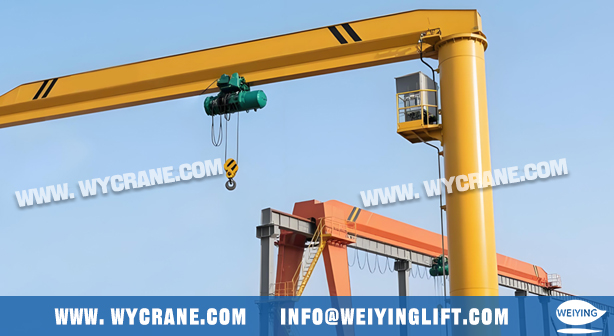
From a pure engineering perspective, jib cranes are designed to handle 100% of their rated capacity at full reach under ideal, static conditions. FEM and ISO duty classifications (such as FEM 1Bm or ISO A5) assume cyclic loading across the full working radius, including the boom tip. So, in theory, the answer is yes.
However, theory and practice diverge in three critical areas: structural behavior, stability margins, and real-world operating conditions.
Structural Limitations
At full reach, the boom experiences its maximum bending stress and deflection. Manufacturers design booms to stay within acceptable deflection limits—commonly L/225 (where L is the boom length), though some specify tighter tolerances. Exceeding the rated load, even slightly, can cause permanent deformation, fatigue cracking at the boom root weld, or excessive sag that changes the geometry of the lift. Operators should visually monitor for abnormal bounce or sag; these are early warnings that the load is too heavy for the radius.
Stability Limitations
Stability is about the foundation, not just the steel. The overturning moment at full reach tries to rotate the crane base out of the concrete. The foundation and anchor bolts must provide a resisting moment significantly greater than the applied moment—typically with a safety factor of at least 1.5. If the concrete is cracked, anchor bolts are loose, or the soil has settled unevenly, the crane may be structurally intact but stability-compromised. A crane can lift its rated load at full reach on Monday and fail on Tuesday if the foundation degrades.
When the Answer Becomes “No”
Full-reach lifting becomes unsafe when:
- Side loading is introduced (dragging the load horizontally or lifting at an angle).
- Dynamic amplification occurs from sudden starts, stops, or swinging.
- Wind loads act on outdoor cranes, adding lateral force at the worst possible mechanical advantage.
- The duty cycle is exceeded, causing fatigue accumulation in the boom and bearings.
Critical Safety Factors for Full-Reach Operation
Lifting at full reach magnifies every risk. The following factors must be actively managed.
Dynamic and Impact Loads
A static load chart does not account for real-world physics. When a hoist accelerates to lift a load, or when a trolley traverses, the sudden force creates a dynamic amplification factor typically ranging from 1.15 to 1.33. At full reach, this amplified moment is at its maximum. Operators must avoid “snatching” the load off the ground. Smooth, controlled acceleration is not just good practice—it is a structural necessity.
Boom Deflection and Elastic Deformation
All steel booms deflect under load. At full reach, this deflection is most visible. While elastic deflection is normal and expected, excessive deflection indicates the load is approaching the structural limit. More importantly, deflection slightly increases the effective radius, which in turn slightly increases the moment—a secondary effect that design codes account for, but only within rated limits.
Foundation and Anchor Integrity
The most dangerous failures are often below ground level. Before any full-reach lift, inspect the base plate, concrete pedestal, and anchor bolts for cracks, corrosion, or loosening. Re-torque bolts per the manufacturer’s schedule. If the foundation shows any sign of distress, full-reach operation should be suspended until a structural engineer evaluates the system.
Hoist, Rigging, and Below-the-Hook Equipment
The hoist itself must be rated for the full load, including the weight of slings, spreader bars, or vacuum lifters. A common mistake is calculating only the raw material weight while ignoring the 200–500 kg of rigging hardware. At full reach, any eccentric loading—a load hanging off-center—creates torsion and side-bending that the boom was not designed to handle.
Operator Behavior
Human error is the variable engineering cannot fully solve. Two critical rules apply:
- Lift vertically first, then slew. Never drag a load horizontally to extend its reach; this introduces side pull that multiplies stress in the boom and bearing.
- Avoid centrifugal force. Slewing too quickly at full reach causes the load to swing outward, effectively increasing the radius beyond the charted limit.
Environmental and Site Conditions
For outdoor jib cranes, wind is the silent enemy. A 2-ton load at full reach presents a large sail area. Most manufacturers specify wind speed limits (often 20–25 mph) for safe operation. Additionally, verify clearance from walls, columns, or overhead power lines at maximum radius—deflection can temporarily reduce these margins.
Best Practices for Safe Lifting at Full Reach
Safe full-reach lifting is a discipline, not just a calculation.
1
Plan every lift. Verify the load weight against the load chart at the full radius. Include rigging weight. If the total approaches the rated limit, reduce the radius or upgrade the crane.
2
Inspect before critical lifts. Check boom root welds, slewing bearing bolts, base plates, and concrete condition. Look for paint cracks that may signal underlying metal fatigue.
3
Test deflection. During commissioning or after major repairs, perform a static load test at 125% of rated capacity (per local regulations) and measure boom deflection at full reach. This establishes a baseline for future inspections.
4
Control the load path. Use tag lines to prevent swing. Accelerate and decelerate smoothly. Never use the crane to pull or drag loads into position.
5
Maintain rigorously. Schedule periodic re-torquing of anchor bolts, non-destructive testing (NDT) of boom welds, and bearing lubrication. Fatigue from repeated full-reach cycles accumulates over years, not days.
Conclusion
A jib crane can absolutely lift at full reach—but only because it was engineered to do so within a precise envelope of load, geometry, and condition. The danger lies not in the reach itself, but in the assumptions operators make about it. Full-reach capacity is not a suggestion; it is a hard limit derived from structural analysis, foundation stability, and duty-cycle fatigue. Respect the load chart, account for dynamic amplification, maintain the foundation and anchor system, and operate with deliberate control. When these elements align, full-reach lifting is not only possible—it is exactly what the crane was built to do.
Full-reach capacity is a designed limit, not a suggestion.
Respect the load chart, account for dynamic amplification, and keep the foundation and anchor system in perfect condition.
FAQ
Q1: Can a jib crane lift a load at full reach?
A: Yes. Jib cranes are engineered to lift their rated Safe Working Load (SWL) at the full boom extension (maximum radius), provided the load is within the manufacturer’s load chart, the foundation is intact, and the lift is performed under static, vertical conditions without side loading or dynamic shock.
Q2: Is it safe to lift at the very end of the jib crane boom?
A: It is safe only if the load weight is within the rated capacity for that radius and all safety protocols are followed. Full reach generates the highest overturning moment and boom deflection, so foundation stability, anchor bolt integrity, and smooth operator control are critical.
Q3: Does lifting capacity decrease as the boom extends?
A: For standard fixed-boom pillar and wall-mounted jib cranes, the rated capacity is typically constant across the entire boom length. However, for articulating or luffing jib cranes, capacity may decrease as the geometry changes. Always consult the specific load chart for your crane model.
About us

With 34 years of manufacturing experience and 12 years of export expertise, we have built a dual advantage of professional qualifications and a global presence. Our business covers more than 100 countries and regions across Asia, Europe, the Americas, Africa, and Oceania. We are certified under the ISO management system and hold CE product certifications. Our main product lines include six major series—electric hoists, electric winches, gantry cranes, bridge cranes, marine cranes, and portal cranes—comprising nearly 100 different models.
If you want to learn more, please contact us.