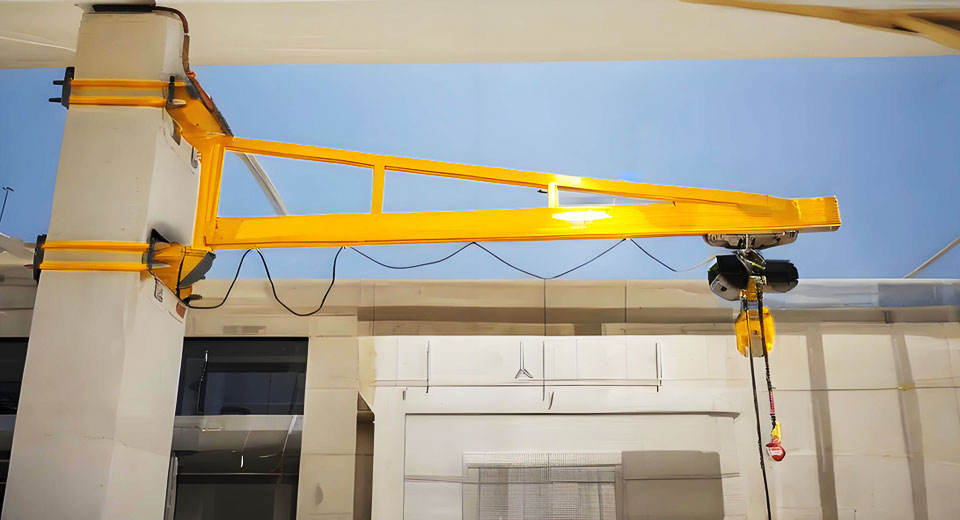
A wall-mounted jib crane is a material-handling device rigidly fixed to building walls or structural columns, specifically engineered to maximize space utilization and optimize workflow efficiency. Characterized by its rotating jib arm and integrated hoisting mechanism, this equipment enables three-dimensional precision in material transfer within a typical operational radius of 3–15 meters. Classified under “limited-range cranes” per ISO 4301-1:2016 standards, it is a cornerstone solution for industrial and logistical operations requiring confined-space maneuverability.
• Jib Arm: Fabricated from Q345B high-strength alloy steel with a box-section profile (200×300 mm typical), offering a yield strength ≥345 MPa to minimize deflection.
• Column Mounting Assembly: Secured via eight M24 grade 10.9 high-tensile bolts (preload: 400 kN) for structural integrity.
• Slewing Ring: Equipped with four-point contact ball bearings (600 mm diameter) for 360° continuous rotation and static load capacity up to 150 kN·m.
• Electric Hoist: Standard 0.25–5-ton chain hoist with adjustable lifting speeds (0.8–8 m/min), compliant with FEM 2m duty classification.
• Travel Mechanism: Variable-frequency-controlled three-phase asynchronous motor (0.75–3 kW) with hysteresis braking, achieving ±1 mm positioning accuracy.
• Control System: PLC-integrated HMI touchscreen supporting wireless remote control (50 m range) and collision-avoidance protocols.
• Overload Protection: Electronic load cell (accuracy ±0.5%).
• Motion Limitation: Redundant limit switches + mechanical end stops.
• Emergency Braking: Spring-applied fail-safe brake (response time <0.2 s).
| Type | Max Load Capacity | Effective Radius | Rotation Angle | Key Applications | |
| Fixed Wall-Mounted | 0.5–2 t | 2–6 m | 180° | Workshop | |
| Wall-Rail Mobile | 1–5 t | 4–10 m | 270° | Assembly line material transfer | |
| Low Headroom | 0.25–1 t | 1.5–3 m | 180° | low-clearance areas |
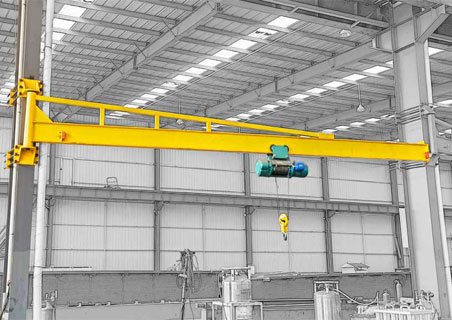
During operation, the jib arm’s root section withstands combined loads calculated as:
M =F × L + ½qL2
Where:
• M = Bending moment at root (kN·m)
• F = Rated load (kN)
• Q = Jib self-weight per unit length (kN/m)
• L = Effective jib length (m)
Modern designs employ finite element analysis (FEA) to optimize stress distribution, ensuring maximum equivalent stress ≤70% of material allowable limits. Deflection is strictly controlled to , with pre-cambering techniques compensating for deformation.
In engine assembly lines, 3-ton cranes with vision-guided systems achieve precise cylinder block-crankshaft alignment, reducing cycle time to 45 seconds/unit.
Integrated with AS/RS systems, 2-ton rail-mounted covers 100-meter rack zones at 4.5 pallets/m² storage density.
• Explosion-proof models for petrochemical plants.
• Stainless steel variants in marine platforms.
• Arctic-grade units operational at -40°C.
1. Space Optimization: Reduces ground space occupation by 65% and vertical clearance requirements by 40% vs. overhead cranes.
2. Energy Efficiency: Consumes 0.15 kWh/ton per lift, 52% lower than conventional systems.
3. Cost-Effectiveness: annual maintenance under $500.
4. Scalability: Modular design supports future upgrades.
• Concrete walls: Thickness ≥300 mm, strength grade ≥C30, reinforcement ratio >0.6%.
• Steel supports: Column cross-section ≥200×200 mm, wall thickness ≥10 mm, foundation depth ≥1.5 m.
• Dynamic load analysis: Includes 1.25x impact factor and 0.5 kN/m² wind load.
| Parameter | Standard Configuration | Specialized Options |
| Temperature Range | -20°C to +40°C | -50°C to +60°C (low-temp) |
| IP Rating | IP54 | IP66 (dust/waterproof) |
| Corrosion Resistance | Epoxy coating | Hot-dip galvanizing (80 μm) |
• Rail straightness tolerance ≤1/1000.
• Jib levelness error ≤2 mm/m.
• Insulation resistance ≥10 MΩ (tested at 500 V).
1. Digital Twin Integration: Real-time monitoring of stress/strain via IoT sensors for predictive maintenance.
2. Autonomous Navigation: SLAM-enabled obstacle avoidance and path optimization.
3. Energy Management: AI-driven operational parameter adjustments to minimize power consumption.
4. Human-Machine Interface: AR-assisted operation with 98% accuracy voice-command recognition.
wall-mounted jib cranes are evolving from basic lifting tools into intelligent material-handling nodes. Their technological progression—centered on space efficiency, precision control, and smart collaboration—continues to drive manufacturing and logistics innovation. With advancements in materials science and AI integration, these cranes will play pivotal roles in flexible production systems and micro-logistics networks, cementing their status as indispensable assets in modern industrial ecosystems.
For more information, feel free to contact us! We are happy to provide advice and tailor solutions for you!
We have 34 years of manufacturing experience and 12 years of export experience,business covers over 100 countries and regions worldwide, including Asia, Europe, America, Africa, and Oceania, forming a global product sales network.Received ISO system certification and CE product certification!
Our main products include 6 series of nearly 100 varieties, including electric hoists, electric winches, gantry cranes, bridge cranes, marine cranes, and gantry cranes.
E-mail: karida@weiyinglift.com
Website: www.wycrane.com