Both jib cranes and workstation cranes solve the same problem — getting a hoist directly to the point of work without waiting for a shared overhead crane. But they solve it with completely different geometry, and that geometry determines almost everything: what you can cover, how your workstations can grow, what your building must support, and what you’ll pay.
If you’ve already confirmed a jib crane fits your application and you’re working out sizes, see our guide on how to size a jib crane. This article answers the earlier question: which system should you be sizing at all?
First, a quick definition, because “workstation crane” means something specific in the industry.
What Counts as a “Workstation Crane”?
A
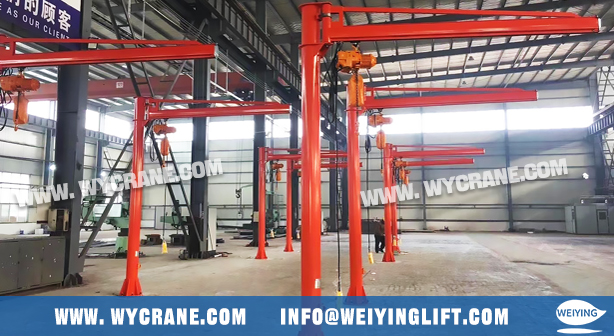
jib crane is a single column or wall bracket supporting a rotating boom, with a hoist traveling along the arm. It covers a circle or fan-shaped sector around one fixed point.
A
workstation crane — usually a
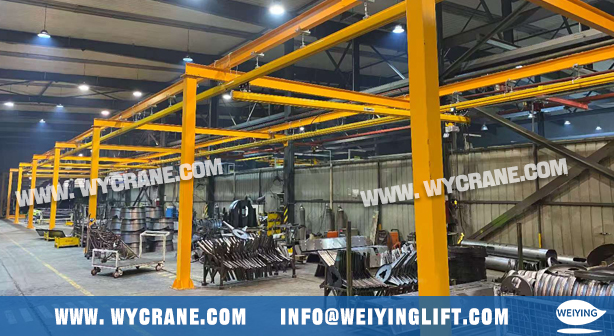
KBK-style modular light crane system — works differently. It uses enclosed steel or aluminum track: one or more bridges (the “main beams”) roll along parallel runways, and the hoist travels along each bridge. The result is a rectangular lifting area instead of a circle. Two support styles exist:
-
Ceiling-suspended: tracks hang from roof structure or an engineered steel framework.
-
Freestanding: self-supporting columns anchored to floor plates — no deep foundations, but columns occupy floor space.
Aluminum track versions handle manual push-pull loads up to roughly 500 kg with near-effortless movement; steel versions run electrically at capacities up to about 2–3 t. With that established, here’s the head-to-head across the five dimensions that matter.
Quick Comparison Table
| Factor |
Jib Crane |
Workstation Crane (KBK) |
| Coverage geometry |
Circle / sector around one point |
Rectangle: span × runway length |
| Typical coverage |
Arm radius 3–7 m |
Configurable from one cell to a whole bay |
| Workstation relationship |
One column, one hook, one station |
One system serves many stations; multiple bridges possible |
| Expansion |
New foundation per added unit |
Modular bolt-together extension |
| Installation |
Foundation or structural column/wall |
Ceiling structure (suspended) or floor plates (freestanding) |
| Typical capacity |
0.25–5 t |
0.125–0.5 t (aluminum) / up to ~3.2 t (steel) |
| Budget per single station |
Lower |
Medium–high |
1. Coverage Area: Circle vs Rectangle
A jib crane covers a ring around its column — and remember, the inner part of that ring near the column is a blind zone the hook can’t reach. Everything the crane can do happens inside one arm radius, typically 3–7 m. If your work moves outside that circle, the jib simply has no answer.
A workstation crane covers a rectangle: the bridge span side-to-side, the runways front-to-back. You size the rectangle to your cell and trim off the waste. This makes KBK systems fundamentally better at two layouts:
-
Rows of stations: three assembly positions in a line are covered by one runway and two or three bridges — where a jib solution needs three separate columns and foundations.
-
Large or elongated cells: a 10 m × 6 m work area is routine for KBK and impossible for any single jib.
The geometric test is simple: is your lifting a point, or a plane? A point inside a 7 m radius favors the jib. A line or an area favors KBK.
2. Workstation Layout: Point Solution vs Line Solution
The jib crane’s strength is intimacy. The hook hangs directly above one workstation, the operator rotates the arm by hand or button, and the whole pick-position-place cycle happens within a few square meters. Machine loading, single assembly cells, and maintenance bays — fixed, concentrated work — are its home ground.
The workstation crane’s strength is sharing. One system can carry multiple bridges running independently, so two or three operators lift simultaneously without queuing. Bridges can also hand loads to each other across runway junctions, enabling genuine material flow between stations. Assembly lines, packing areas, and inspection lines benefit directly.
The trade-off: a KBK bridge covers a wide area, but the hook may sit several meters from where you are — moving it means pushing or driving the bridge. For pure “last meter” responsiveness at one station, the jib still feels better.
Decision signal: count your lifting points. One or two fixed points → jib. A row or a field of points → KBK.
3. Expansion and Reconfiguration
This is where the two systems diverge most sharply over a factory’s lifetime.
Adding jib capacity means pouring new concrete. Each additional column is a foundation project: excavation, anchor bolts, curing time, and a fixed position that may become obsolete when the layout changes. Extending an arm usually means replacing it or upsizing the whole crane.
KBK is modular by design. Tracks bolt together, so you can lengthen runways, add spans, add bridges, or relocate suspension points — and aluminum systems can be dismantled and reassembled at a new site with high residual value.
Planning implication: if your station layout will change or grow within three years, KBK’s upfront premium is usually recovered in avoided modification costs. One caveat: expansion is only possible within the original system’s span and capacity envelope, so confirm module-series compatibility before buying.
4. Installation Conditions
Each system bets on a different part of your building:
-
Jib cranes bet on the ground (or the walls). Floor-mounted units need bearing capacity plus an overturning-moment check at the foundation — once poured, the position is permanent. Wall-mounted units must bolt to structural columns, never infill walls, and transfer a significant moment into the building frame. Full swing clearance around the boom is mandatory.
-
Suspended KBK bets on the roof. You need verified roof steel capacity for suspended loads plus dynamic factors. In older buildings this often means reinforcement — check beam spacing, existing deflection, and interference with overhead cranes, ducts, and cable trays.
-
Freestanding KBK bets on floor space. Floor plates with chemical anchors avoid foundations entirely and suit tenants or poor soils — at the cost of columns standing inside the work area.
In short: the jib bets on the floor, suspended KBK bets on the roof, freestanding KBK bets on floor space. Run the elimination pass on your building before falling in love with either system.
5. Budget: Initial Price vs Total Cost
On a strictly single-station basis, the jib crane wins the purchase order almost every time — one column and one hoist against a run of track and structure. But that comparison misleads if your real need spans several stations. Compared per square meter of coverage, KBK frequently comes out cheaper once it serves three or more workstations.
Look at total cost of ownership, not the invoice:
-
Installation: jib = foundation civil work; suspended KBK = lifting equipment and working at height.
-
Modification: KBK’s bolt-together structure wins every time (see Section 3).
-
Maintenance: a jib has one brake, one rope, one trolley; KBK spreads wear across more wheels and track but each component is inexpensive.
-
Downtime: a jib failure idles one station; a KBK failure can idle a row — mitigate with multiple bridges so one remains operational.
Bottom line: budget questions are meaningless until you anchor them to the number of stations covered. “Which is cheaper?” must always be “cheaper for this layout?”
Decision Matrix: Which One for Your Factory?
| Your situation |
Recommended |
| 1–2 fixed stations, short local lifts |
Jib crane |
| A full assembly line or continuous stations |
Workstation crane |
| Layout expected to change within 3 years |
Workstation crane |
| Usable structural columns/walls; don’t want to touch the floor |
Jib crane (wall-mounted) |
| Weak roof that can’t be reinforced |
Freestanding KBK or floor-mounted jib |
| Very light loads (<500 kg) with frequent manual movement |
KBK aluminum track |
| Tight budget, single station |
Jib crane |
| Multiple hooks working simultaneously |
KBK with multiple bridges |
The Hybrid Layout
One more option worth naming: the two systems combine well. Let a KBK line or your existing overhead crane handle trunk transport between areas, and put a jib crane at each machine for the last meter of loading. Each system does what it’s geometrically best at, and neither queue feeds the other.
Conclusion
Neither crane wins this comparison in the abstract — they cover different shapes. The jib crane is the point tool: cheapest per station, most responsive within its radius, but anchored to a foundation and a circle. The workstation crane is the area tool: costlier at one station, unbeatable across a row or a field, and reconfigurable as your factory evolves.
So run the checks in order: sketch your lifting points — are they a point or a plane? Audit your building — floor, roof, or open floor space: which one can you bet on? Project five years ahead — will this layout still exist? Anchor the budget to the stations actually covered. Answer those four questions, and the right system is usually obvious before you ever request a quote.
FAQ
What is the difference between a jib crane and a workstation crane?
A jib crane rotates a boom around one column to cover a circular area; a workstation crane moves bridges along parallel runways to cover a rectangular area. The jib serves one station intensely; the workstation crane serves many stations or a full line.
Is a KBK crane the same as a workstation crane?
Practically, yes — “KBK” is the genericized trademark for modular enclosed-track light crane systems, which is what the industry means by “workstation crane.” Aluminum and steel track variants exist for different capacities.
Can a workstation crane replace an overhead crane?
For loads up to about 3 t within one bay, often yes — at much lower cost. Beyond that capacity or span, or where high duty cycles are involved, a full overhead crane remains the correct tool.
Which is cheaper, a jib crane or a KBK system?
For one station, the jib crane. For three or more stations within one area, KBK’s cost per covered square meter usually wins. Always compare total cost including installation and future modification, not just purchase price.
How much ceiling structure do I need for a suspended workstation crane?
Your roof steel must carry the system’s dead load plus lifted loads with a dynamic factor, at the suspension point spacing specified by the manufacturer. Have a structural engineer verify older buildings — reinforcement is common and must be budgeted.
Can I install a workstation crane on the floor without foundations?
Yes — freestanding workstation cranes use columns on floor plates secured with chemical or expansion anchors. No excavation is needed, but the columns occupy floor space inside the work area.
About us

With 34 years of manufacturing experience and 12 years of export expertise, we have built a dual advantage of professional qualifications and a global presence. Our business covers more than 100 countries and regions across Asia, Europe, the Americas, Africa, and Oceania. We are certified under the ISO management system and hold CE product certifications. Our main product lines include six major series—electric hoists, electric winches, gantry cranes, bridge cranes, marine cranes, and portal cranes—comprising nearly 100 different models.
If you want to learn more, please contact us.
E-mail address: info@weiyinglift.com
Website:www.wycrane.com