Selecting the right lifting equipment is one of the most critical decisions in facility design. Choose incorrectly, and you face production bottlenecks, safety hazards, and wasted capital. In industrial material handling, the debate between jib cranes and overhead cranes (also known as bridge cranes or EOT cranes) is fundamental. While both serve the same core purpose—lifting and moving heavy loads—their structural designs, operational capabilities, and ideal use cases differ dramatically. This guide breaks down what each system is, how they compare, and provides a practical framework for making the right choice.
What Is a Jib Crane?
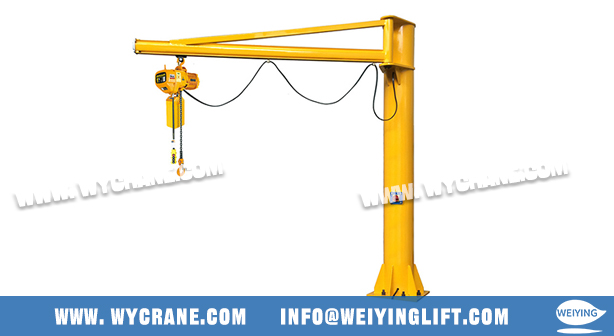
A jib crane is a type of workstation crane featuring a horizontal boom (jib arm) attached to a vertical support structure—typically a floor‑mounted pillar, a wall‑mounted bracket, or a building column. The arm rotates around its support point, creating a circular or semi‑circular coverage area.
Types and Classification
Jib cranes are classified primarily by their mounting method:
-
Floor‑Mounted / Pillar‑Mounted: Free‑standing units anchored to a concrete foundation. They offer the widest rotation (up to 360°) and highest capacity among jib types.
-
Wall‑Mounted: Bolted directly to existing load‑bearing walls. They require no floor foundation and save valuable floor space, though rotation is typically limited to 180°–270°.
-
Mast‑Type: Supported by both the floor and an overhead building structure, eliminating the need for a massive foundation.
-
Articulating: Feature multiple pivot points (knuckle booms) for maneuvering around obstacles.
By operation mode, they range from manual chain‑hoist models to fully motorized and hydraulic systems. Duty classes span from light standby service (A1–A2) to moderate continuous use (C‑class).
Key Characteristics
Jib cranes excel at localized, repetitive lifting tasks. They typically handle loads from 0.125 to 10 tons (standard models), occupy minimal space, and feature relatively simple installation—especially wall‑mounted variants. Their primary strength is delivering precise, point‑to‑point lifting within a defined workstation without interfering with other operations.
What Is an Overhead Crane?
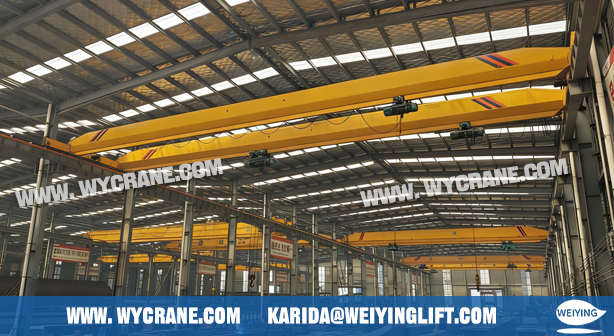
An overhead crane (bridge crane or EOT crane) consists of one or two bridge girders that travel along elevated runways supported by building columns. A trolley and hoist assembly moves across the bridge, enabling three‑axis movement (hoist lift, trolley travel, and bridge travel).
Types and Classification
Overhead cranes fall into several structural categories:
-
Single Girder: One main beam with the hoist running underneath. Cost‑effective for lighter loads (up to ~20 tons).
-
Double Girder: Two parallel beams with the hoist mounted between them. Handles heavier loads (up to 500+ tons) and provides greater hook height.
-
Top‑Running: The bridge rides on top of the runway beams, maximizing lifting height.
-
Underhung / Underslung: The bridge hangs from the bottom flange of the runway, ideal for facilities with limited headroom.
Related systems include gantry cranes (self‑supported with legs), monorail cranes (single track for linear paths), and workstation bridge cranes (enclosed track systems for lighter loads).
Key Characteristics
Overhead cranes dominate facility‑wide material handling. They cover rectangular areas spanning entire production bays, handle significantly heavier loads, and can be automated or integrated with building management systems. However, they require substantial overhead structural support, complex installation, and higher capital investment.
Core Differences: Jib Crane vs Overhead Crane
Understanding the structural and operational distinctions is essential for proper selection.
Coverage Area and Movement
The most obvious difference is geometry. A jib crane operates within a circular or semi‑circular arc around its support point. An overhead crane covers a full rectangular area defined by the runway span and building length. If your operation requires moving materials from one end of a 100‑meter bay to the other, only an overhead crane can do it efficiently.
Load Capacity
Jib cranes are workstation tools. Standard capacities rarely exceed 10 tons, with most applications falling between 0.5 and 5 tons. Overhead cranes are built for heavy industry, routinely handling 20 to 100 tons, with specialized units exceeding 500 tons in steel mills and shipyards.
Space and Installation
A wall‑mounted jib crane requires virtually no floor space and minimal overhead room. A floor‑mounted jib needs only a small foundation footprint. In contrast, an overhead crane demands runway beams along the building span, adequate headroom for the bridge and hoist, and often structural reinforcement of the building frame. Installation is significantly more complex and time‑consuming.
Cost and Maintenance
Jib cranes offer lower initial investment and simpler maintenance due to fewer moving parts. Overhead cranes carry higher upfront costs (equipment + runway installation) and require more rigorous maintenance schedules, including runway alignment checks and trolley system inspections.
Applications and Use Cases
Where Jib Cranes Excel
-
Individual Workstations: CNC machine loading, assembly stations, and welding booths where operators need frequent, short‑distance lifts.
-
Maintenance Bays: Engine repair, pump servicing, and equipment overhaul requiring precise load positioning.
-
Loading Docks: Supplementary lifting for trucks and shipping containers.
-
Mold and Die Handling: Quick die changes in stamping and injection molding operations.
-
Confined Spaces: Low‑ceiling workshops where overhead runways are impossible.
Where Overhead Cranes Excel
-
Heavy Manufacturing: Steel fabrication, automotive assembly, and foundries moving massive raw materials.
-
Warehousing and Logistics: Full‑bay coverage for palletized goods and container handling.
-
Aerospace and Power Generation: Moving oversized, high‑value components across large facilities.
-
Ports and Shipyards: Gantry crane variants loading and unloading vessels.
Working Together
Importantly, these systems are not mutually exclusive. Many facilities deploy overhead cranes for inter‑station transport while installing jib cranes at individual workstations. This hybrid approach reduces overhead crane idle time and eliminates operator waiting periods.
Real‑World Case Study
A European agricultural machinery manufacturer faced a classic bottleneck: 20 CNC workstations shared just two large overhead bridge cranes. Operators spent an average of 40 minutes per shift waiting for crane availability, directly limiting output.
The solution was not larger overhead cranes, but targeted deployment of 10 floor‑mounted jib cranes—one serving every two workstations. Each jib crane provided 360° coverage, 1.2‑ton capacity, and independent operation. The result? Waiting time was eliminated entirely, daily machined parts output increased by 25%, and the investment paid for itself in under six months.
This case illustrates a critical principle: the most expensive crane is the one you use for tasks it was never designed to handle.
How to Choose: A Practical Decision Framework
Use these seven criteria to guide your selection:
1. Coverage Requirements Need full‑bay rectangular coverage? Choose an overhead crane. Need circular workstation coverage? A jib crane is optimal.
2. Load Capacity Routine loads under 10 tons point toward a jib crane. Loads exceeding 10 tons, or frequent heavy‑duty cycles, demand an overhead crane.
3. Available Space Limited floor space and low ceilings favor wall‑mounted jib cranes. Adequate overhead structure and headroom are prerequisites for overhead cranes.
4. Frequency and Duty Cycle Intermittent, repetitive workstation lifting suits jib cranes. Continuous, high‑volume bay‑wide handling requires overhead crane durability.
5. Budget Constraints Lower initial investment and faster installation make jib cranes attractive for budget‑conscious projects. Overhead cranes require higher capital but deliver facility‑scale capability.
6. Building Structure Can your walls support a wall‑mounted jib? Can your building frame accommodate runway beams? A structural engineering assessment is non‑negotiable for overhead crane installation.
7. Future Scalability Plan for expansion. Overhead crane runways can often be extended. Jib cranes are easier to relocate (especially wall‑mounted) but serve fixed workstations.
Quick Reference Matrix
|
Factor
|
Choose Jib Crane
|
Choose Overhead Crane
|
|
Coverage
|
Localized / circular
|
Full bay / rectangular
|
|
Capacity
|
≤ 10 tons
|
> 10 tons
|
|
Space
|
Limited floor/headroom
|
Adequate overhead structure
|
|
Budget
|
Lower initial cost
|
Higher capital acceptable
|
|
Frequency
|
Workstation repetitive
|
Continuous bay-wide
|
Conclusion
The jib crane vs overhead crane decision is not about finding the “best” crane—it is about matching the right lifting technology to your operational reality. Jib cranes are precision workstation tools: compact, cost‑effective, and ideal for localized, repetitive tasks. Overhead cranes are facility backbone systems: powerful, wide‑reaching, and essential for heavy, bay‑scale material flow.
For many operations, the optimal solution is a combination of both. Start by mapping your workflow, quantifying your loads, and assessing your space. When in doubt, consult a professional engineer for a site‑specific structural and operational assessment. The right choice today prevents costly retrofitting tomorrow.
FAQ
Can a jib crane replace an overhead crane?
No, not in most cases. A jib crane is designed for localized, workstation‑level lifting within a circular area, while an overhead crane is built for facility‑wide material transport across entire production bays. If your operation requires moving heavy loads from one end of a large workshop to another, or handling loads above 10 tons routinely, an overhead crane is irreplaceable. However, jib cranes can reduce overhead crane workload by handling repetitive station‑level tasks independently.
What is the main difference between a jib crane and an overhead crane?
The fundamental difference lies in coverage area and structural support. A jib crane uses a single vertical support (pillar, wall, or mast) and rotates in a circular arc. An overhead crane travels on elevated runways along the building span, covering a rectangular area with three‑axis movement (hoist, trolley, and bridge). Additionally, overhead cranes typically handle significantly heavier loads and require complex building‑integrated installation.
Which is more cost‑effective: a jib crane or an overhead crane?
For localized, light‑to‑medium duty applications, jib cranes are far more cost‑effective. They require lower initial investment, simpler installation (especially wall‑mounted models), and minimal maintenance. Overhead cranes involve higher upfront costs due to runway beams, structural assessments, and complex installation. However, for heavy‑duty, full‑facility operations, the overhead crane’s productivity gains justify its higher total cost of ownership.
About us

With 34 years of manufacturing experience and 12 years of export expertise, we have built a dual advantage of professional qualifications and a global presence. Our business covers more than 100 countries and regions across Asia, Europe, the Americas, Africa, and Oceania. We are certified under the ISO management system and hold CE product certifications. Our main product lines include six major series—electric hoists, electric winches, gantry cranes, bridge cranes, marine cranes, and portal cranes—comprising nearly 100 different models.
If you want to learn more, please contact us.
E‑mail address: info@weiyinglift.com
Website: www.wycrane.com