

Selecting the right jib crane boom length is one of the most critical yet frequently miscalculated steps in workstation lifting design. Specify a boom that is too short, and your operators cannot reach critical load positions, creating production bottlenecks and unsafe manual handling workarounds. Specify one that is too long, and you pay for unnecessary steel, a larger foundation, and—most importantly—a potentially dangerous reduction in jib crane capacity due to increased moment forces. This guide walks you through how to measure your workspace, balance reach and capacity, and select the optimal jib crane span for your operation.
What Is Jib Crane Reach? Key Terminology
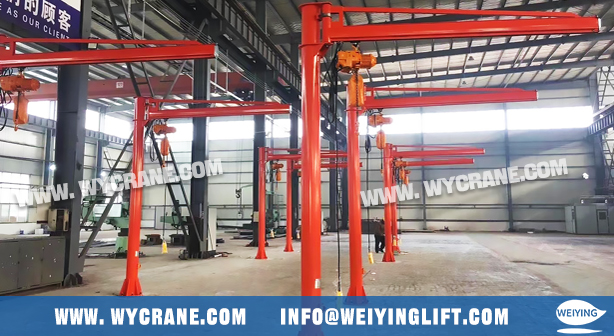
Before calculating anything, it is essential to understand the three terms manufacturers use to describe coverage.
Boom Length (Jib Span)
Boom Length (Jib Span) refers to the horizontal distance from the centerline of the pivot point to the physical end of the jib arm. Standard jib crane spans range from 2 meters to 6 meters for most industrial models, though custom designs can extend to 10 meters or more.
Working Radius (Working Reach)
Working Radius (Working Reach) is the practical horizontal distance from the pivot center to the hook center at full trolley extension. This is the number that actually matters on your shop floor, because it defines the real jib crane coverage area your operators can access. Depending on trolley and hoist dimensions, the working radius is typically 150–300 mm shorter than the nominal boom length.
Coverage Area (Work Envelope)
Coverage Area (Work Envelope) describes the total floor area the crane can service. For a pillar-mounted jib crane with 360° rotation, this is a full circle (πr²). For a wall-mounted jib crane with 180° rotation, it is a semi-circle. Understanding this envelope prevents overlap conflicts when multiple cranes are installed in proximity.
How to Measure and Calculate Your Required Workspace
Accurate measurement is the foundation of correct jib crane reach selection. Follow this three-step process before contacting any supplier.
1
Map Your Workstation Layout. Identify the exact mounting location—whether a floor-mounted pillar center or a wall bracket position. From that point, mark every location where a load must be picked up or set down. Measure the horizontal distance from the mount center to the farthest active point in the work zone.
2
Add Operational Clearance. Never size the boom to match the farthest point exactly. Loads swing. Operators need walking space. Obstructions exist. Add a minimum safety margin of 0.3 to 0.5 meters beyond the farthest measured point. Your minimum required working radius should follow this formula: Minimum Working Radius = Maximum Distance to Load + 0.5 m Clearance.
3
Account for Vertical Envelope. Measure the Height Under Boom (HUB)—the distance from the floor to the underside of the jib arm. Ensure this height accommodates the hoist body, sling or lifting attachment, and the load itself, while clearing any overhead obstructions such as ducts, lights, or building beams.
The Critical Trade-Off: Boom Length vs Load Capacity
This is where many buyers make expensive mistakes. Boom length and lifting capacity are not independent variables—they are fundamentally linked by physics.
M = F × L
Bending Moment = Force × Length — the core equation behind every boom-length decision
The bending moment on the jib structure follows the formula M = F × L (Moment equals Force multiplied by Length). A 1,000 kg load at a 3-meter jib crane working radius creates 3,000 kg·m of moment. Move that same load to a 5-meter radius, and the moment jumps to 5,000 kg·m—a 67% increase in structural stress. The crane must be built stronger, heavier, and more expensive to handle that difference safely.
Manufacturers publish jib crane load charts that show rated capacity decreasing as radius increases. A crane cataloged as “2-ton” may only deliver that full capacity at its shortest radius. At 5 meters, the same unit might be rated for just 1.2 tons. Always read the load chart at your required radius, not the headline catalog rating.
Deflection is another hidden cost of excessive span. Industry standards typically limit boom tip deflection to L/250. On a 4-meter boom, that means 16 mm maximum sag. On a 6-meter boom, deflection increases dramatically—often exceeding 36 mm under load. Excessive sag causes load swing, reduces positioning precision, and increases operator fatigue. For applications requiring precise placement—such as CNC machine loading or delicate assembly—shorter, stiffer booms significantly outperform longer ones.
Standard Boom Length Ranges and Their Applications
Understanding where standard spans fit helps anchor your selection in reality.
| Reach Range | Typical Capacity | Typical Applications |
|---|---|---|
| Short Reach (2–3 m) | 0.5 – 5 tons | Single-machine service, tight maintenance bays, narrow assembly aisles; often wall-mounted |
| Medium Reach (3–5 m) | 0.25 – 3 tons | Two to three adjacent workstations, standard CNC cells, typical assembly bays |
| Long Reach (5–8 m) | 0.5 – 2 tons | Warehouse loading zones, open fabrication halls, multi-station line service |
| Extra-Long Reach (8+ m) | > 1 ton requires custom engineering | Rare in workstation use; articulating (knuckle-boom) or truss-style designs |
Step-by-Step Selection Framework
Use this systematic approach to eliminate guesswork from your jib crane span selection.
1
Define the Maximum Load. Calculate the heaviest routine load you will lift, then add the weight of the hoist, trolley, slings, and any fixtures. Add a 10–25% dynamic safety margin for acceleration and shock loads. Never select a crane rated exactly at your load weight.
2
Determine Minimum Required Reach. Using the workspace measurement method described above, establish your required working radius including clearance.
3
Match Capacity to Radius on the Load Chart. Request the manufacturer’s load chart and verify that the crane can handle your calculated maximum load at your required working radius. If the chart shows insufficient capacity, you must either reduce the boom length or step up to a heavier crane class.
4
Verify Structural Compatibility. For floor-mounted jib cranes, confirm the foundation can resist the overturning moment at full radius. For wall-mounted jib cranes, have a structural engineer verify that the wall can withstand the moment load imposed at the bracket. This step is non-negotiable for safety.
5
Consider Future Needs. Will your workstation layout expand? Will loads get heavier? Adding 10–15% conservatism to your span and capacity selection prevents premature obsolescence without the cost penalty of major oversizing.
Common Mistakes When Selecting Boom Length
Avoid these five errors that consistently drive poor outcomes.
1
Choosing Radius Based Only on Product Weight. Buyers often forget to include hoist weight, trolley weight, and rigging in their load calculation. These accessories routinely add 5–10% to the total lifted mass, pushing a nominally sized crane into overload.
2
Selecting Catalog Capacity Without Checking the Load Chart. A “2-ton jib crane” headline rating often applies only at the minimum radius. At the 5-meter span you actually need, that same crane may only be rated for 1.5 tons. Always verify capacity at your specific jib crane working radius.
3
Oversizing “Just to Be Safe.” A longer boom feels like insurance, but it inflates steel costs, foundation size, and installation complexity. More critically, it increases deflection and reduces precision. The golden rule is to specify the shortest boom that meets your verified coverage needs.
4
Ignoring Deflection and Precision Requirements. Long booms sag. If your application involves loading parts into tight machine fixtures or aligning components for assembly, boom deflection can make accurate placement frustrating or impossible. Choose stiffness over reach when precision matters.
5
Forgetting Obstacle Navigation. In crowded workshops, a straight long boom may collide with adjacent equipment, columns, or inventory racks. In these cases, an articulating jib crane with a knuckle boom can navigate around obstacles more effectively than an excessively long straight arm.
Special Considerations by Mounting Type
Your mounting choice directly constrains your jib crane reach options.
Pillar-Mounted (Floor-Mounted)
Pillar-Mounted (Floor-Mounted) Jib Cranes offer the greatest flexibility in boom length, with standard models reaching 6–8 meters and custom designs extending to 10–12 meters. Because they rely on an independent concrete foundation, their span is limited primarily by cost and deflection rather than building structure. They provide full 360° rotation, delivering the largest possible jib crane coverage area per meter of boom length.
Wall-Mounted
Wall-Mounted Jib Cranes are constrained by the strength of the existing building structure. Spans typically range from 2 to 8 meters, but the practical limit is often lower depending on wall material and load-bearing capacity. They offer 180° to 270° rotation, creating a semi-circular work envelope. The primary advantage is zero floor footprint, but never sacrifice a structural engineering review for convenience.
Articulating
Articulating Jib Cranes use dual-pivot arms that fold and extend. Their effective reach varies with articulation angle, making them ideal for navigating around obstacles in confined spaces. Capacities are typically lower (1–2 tons) due to the added joint complexity, but their maneuverability often justifies the trade-off in tight workshops.
Conclusion
Choosing the right jib crane boom length is not about maximizing span—it is about optimizing the intersection of coverage, capacity, structure, and cost. Start by accurately measuring your workspace and defining your true maximum load. Then, use the manufacturer’s jib crane load chart to verify capacity at your required working radius, not just the headline catalog rating. Account for deflection if precision matters, and always have a structural engineer validate foundation or wall capacity before installation.
The most expensive boom is the one that is longer than necessary.Specify the shortest span that meets your operational needs, add a modest future-proofing margin, and you will achieve a safe, efficient, and cost-effective lifting solution that serves your facility for years to come.
FAQ
How do I measure the right boom length for my jib crane?
Start by identifying your crane’s mounting point (pillar center or wall bracket). Measure the horizontal distance from this point to the farthest location where you need to lift or place a load. Add a minimum safety margin of 0.3–0.5 meters to account for load swing, operator walking space, and obstructions. This final number is your required working radius, which determines the boom length you should specify. Remember that the nominal boom length is typically 150–300 mm longer than the actual working radius due to trolley and hoist dimensions.
What is the ideal safety clearance to add beyond my farthest load point?
Industry best practice is to add 0.3 to 0.5 meters beyond the farthest measured load position. This clearance accommodates natural load swing during rotation, operator positioning space, and any unforeseen obstructions. Skipping this margin often results in a crane that technically “reaches” but practically fails to service the workstation safely or efficiently.
How much boom deflection is acceptable for a jib crane?
The industry standard limits boom tip deflection to L/250—meaning a 4-meter boom should deflect no more than 16 mm under rated load. Deflection increases with the cube of span length, so a 6-meter boom can sag more than 36 mm. Excessive deflection causes load swing, reduces positioning precision, and increases operator fatigue. For applications requiring accurate placement—such as CNC loading or assembly—choose a shorter, stiffer boom or a higher-duty model even if the catalog capacity seems sufficient.
About us

With 34 years of manufacturing experience and 12 years of export expertise, we have built a dual advantage of professional qualifications and a global presence. Our business covers more than 100 countries and regions across Asia, Europe, the Americas, Africa, and Oceania. We are certified under the ISO management system and hold CE product certifications. Our main product lines include six major series—electric hoists, electric winches, gantry cranes, bridge cranes, marine cranes, and portal cranes—comprising nearly 100 different models.
If you want to learn more, please contact us.
E-mail address: info@weiyinglift.com
Website: www.wycrane.com