When moving or lifting heavy loads, winches and hoists are two common types of industrial equipment. Because both can use motors, gearboxes, wire ropes, drums, and braking systems, they are sometimes considered interchangeable. However, a winch and a hoist are designed for different primary purposes.
A winch is mainly used to pull, haul, tow, or position a load, while a hoist is primarily designed to lift and lower suspended loads vertically. Understanding this difference is important when selecting equipment for factories, warehouses, construction sites, shipyards, docks, and other industrial applications.
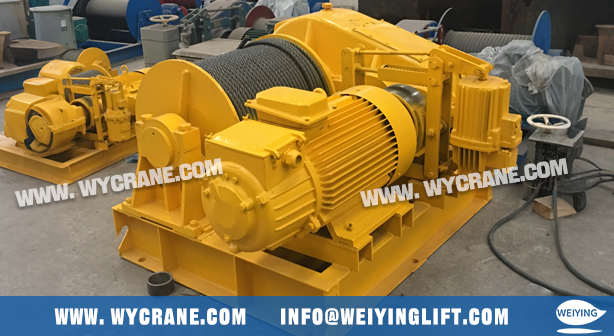
A winch is a mechanical device that uses a drum, rope or wire rope, and a drive system to pull or move a load. An electric winch normally consists of an electric motor, gearbox, drum, brake, wire rope, and control system.
When the motor rotates the drum, the wire rope is wound onto it and generates pulling force. Depending on the application, a winch can move loads horizontally, along an incline, or in certain specially designed applications, vertically.
The main purpose of a winch is therefore pulling and hauling rather than conventional lifting.
Industrial winches are commonly used for:
The most important specifications for a winch often include rated pulling capacity, line speed, rope diameter, drum capacity, motor power, and duty cycle.
It is worth noting that some industrial winches are specifically designed for vertical lifting. However, a general-purpose pulling winch should not automatically be used to lift suspended loads. The manufacturer’s rated application and safety requirements should always be checked first.
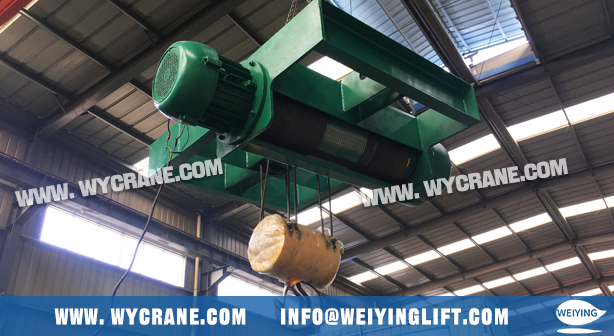
A hoist is a lifting device specifically designed to raise and lower suspended loads. Unlike a general-purpose winch, a hoist is engineered primarily around controlled vertical lifting.
An electric hoist may use a wire rope or chain as the lifting medium. A typical electric wire rope hoist includes a motor, gearbox, lifting drum, wire rope, hook, brake, limit switches, and control system.
Hoists are commonly installed on overhead cranes, gantry cranes, jib cranes, monorails, and workstation cranes.
For example, in a factory, an electric hoist mounted on an overhead crane can lift a 5-ton machine from the floor and then move it horizontally along the crane runway. The hoist provides the vertical lifting function, while the crane and trolley provide horizontal movement.
For this reason, hoists are widely used in:
The key specifications of a hoist normally include lifting capacity, lifting height, lifting speed, duty class, rope or chain type, and power supply.
The easiest way to understand the difference between a winch and a hoist is to consider how the load needs to move.
|
Feature |
Winch |
Hoist |
|
Main function |
Pulling, hauling and positioning |
Lifting and lowering |
|
Typical movement |
Horizontal, inclined or specialized vertical |
Mainly vertical |
|
Common medium |
Wire rope, cable or synthetic rope |
Wire rope or chain |
|
Main capacity |
Pulling force / line pull |
Rated lifting capacity |
|
Typical applications |
Towing, marine, construction, hauling |
Factory and warehouse lifting |
|
Installation |
Frame, platform, vehicle, vessel, etc. |
Crane, monorail, jib or lifting structure |
|
Typical question |
How much can it pull? |
How much can it lift? |
This distinction is more important than simply comparing their motor power or rated tonnage.
For example, if you need to pull a heavy machine across a workshop floor, an industrial winch may be the appropriate choice. If you need to lift the machine from the floor and suspend it several meters above the ground, a suitable hoist is normally the better option.
This is one of the most common questions about winch vs hoist.
The answer depends on the winch design.
Some industrial winches are specifically engineered and rated for vertical lifting. These lifting winches may have suitable brakes, drums, rope arrangements, load controls, and structural components for suspended loads.
However, a standard pulling winch should not be treated as a lifting hoist simply because its pulling capacity is high enough.
When a load is suspended, the equipment must safely control the load during lifting, lowering, stopping, and power interruption. Therefore, if the main application involves repeated vertical lifting, a purpose-designed electric hoist is generally the safer and more practical choice.
The selection process should begin with the actual working requirement rather than the equipment name.
First ask whether the main task is pulling or lifting.
Choose a winch when the load needs to be pulled, hauled, towed, dragged, or positioned. Choose a hoist when the load needs to be raised and lowered vertically.
If the application requires both vertical lifting and horizontal travel, such as moving materials around a factory, an overhead crane with an electric hoist may be a better complete solution.
Do not select equipment based only on the load weight.
For a winch, consider the required line pull, line speed, rope capacity, pulling distance, incline, and duty cycle. For a hoist, consider lifting capacity, lifting height, lifting speed, operating frequency, and duty classification.
The working environment also matters. Indoor factories may have relatively stable conditions, while outdoor, marine, and offshore applications may require additional protection against moisture, corrosion, dust, and temperature variations.
A hoist usually needs to be installed on a suitable supporting structure, such as a crane bridge, trolley, monorail, or jib crane.
A winch may be mounted on a dedicated frame, platform, vehicle, vessel deck, or other structure depending on its design.
Electrical requirements should also be checked, including voltage, frequency, motor power, control method, and available power supply.
There is no universal answer because winches and hoists solve different material-handling problems.
A winch is generally the better choice when the primary requirement is pulling, hauling, towing, positioning, or marine operation. A hoist is normally more suitable when the main task is repeated vertical lifting and lowering of suspended loads.
For example:
The most important rule is to select equipment according to its rated application, capacity, duty cycle, installation conditions, and safety requirements rather than simply comparing tonnage.
The main difference between a winch and a hoist is their intended function. A winch is primarily designed to pull and haul loads, while a hoist is designed to lift and lower suspended loads.
Although some specialized winches can perform vertical lifting, they should only be used for this purpose when specifically designed and rated for it. For regular industrial lifting, an electric hoist is usually the more appropriate solution.
Understanding the difference between winch vs hoist can help you choose the right equipment, avoid unnecessary costs, and ensure that the lifting or pulling system matches the actual working conditions.
A winch is mainly designed for pulling, hauling, towing, and positioning loads, while a hoist is primarily designed for lifting and lowering suspended loads vertically.
Some winches are specifically designed and rated for vertical lifting. However, a general-purpose pulling winch should not be used for suspended-load lifting unless the manufacturer confirms that it is suitable for the application.
Consider the required load movement, capacity, lifting or pulling distance, operating frequency, duty cycle, installation method, working environment, and power supply. If the main task is vertical lifting, a hoist is generally the better choice; if it is pulling or hauling, a winch may be more appropriate.

With 34 years of manufacturing experience and 12 years of export expertise, we have built a dual advantage of professional qualifications and a global presence. Our business covers more than 100 countries and regions across Asia, Europe, the Americas, Africa, and Oceania. We are certified under the ISO management system and hold CE product certifications. Our main product lines include six major series—electric hoists, electric winches, gantry cranes, bridge cranes, marine cranes, and portal cranes—comprising nearly 100 different models.
If you want to learn more, please contact us.
E-mail address: info@weiyinglift.com
Website: www.wycrane.com