When purchasing an overhead crane, most buyers focus on load capacity, span, lifting height, and working class. However, one often overlooked specification has a direct impact on your building utilization and overall working efficiency—the hook approach.
For workshops with limited space, every centimeter matters. A crane with a smaller hook approach can significantly reduce “dead zones” and increase the effective lifting coverage.
So, which type of bridge crane has the smallest hook approach?
The short answer is:
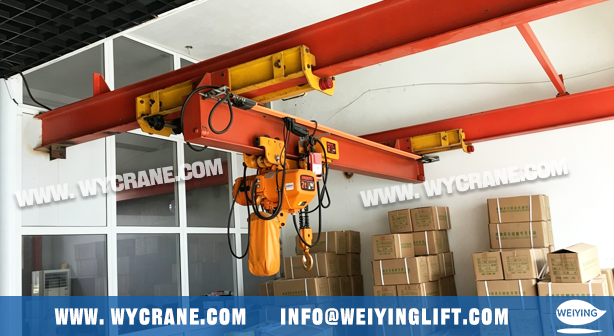
Underhung (suspension) bridge cranes generally offer the smallest hook approach among all overhead crane types.
This article explains why, compares different crane structures, analyzes key influencing factors, and offers practical selection guidance for engineers, integrators, and factory owners.
Hook approach refers to the minimum horizontal distance that the crane hook can reach relative to a physical boundary such as the end wall or the side of the runway beam.
There are two types of hook approach:
A smaller hook approach directly means:
Especially in compact workshops, old buildings, or rental warehouses, reducing the hook approach can save thousands of dollars in structural modification costs.
→ They offer the smallest hook approach among all overhead crane types.
This is because:
In many cases, an underhung crane can achieve end approaches as small as 200–350 mm, significantly shorter than top-running systems.
Underhung cranes are structurally different from top-running cranes. Here are the key reasons they achieve superior hook approach performance:
With the hoist suspended beneath the girder:
Underhung end trucks typically have:
This allows the hook to reach extremely close to both runway ends.
For top-running cranes, the trolley is restricted by:
Underhung cranes avoid these constraints entirely.
The functional benefit is simple:
The hook can cover more corners of your workshop.
For industries where every square meter counts, this alone makes underhung cranes the best choice.
Below is a comprehensive comparison based on typical industrial designs:
| Crane Type | Hook Approach | Space Utilization | Typical Application |
| Underhung Bridge Crane | ⭐ Smallest | ⭐⭐⭐⭐⭐ | Small workshops, assembly lines, low headroom |
| Top-Running Single Girder | ⭐⭐ Medium | ⭐⭐⭐ | Manufacturing, machining |
| Top-Running Double Girder | ⭐⭐⭐ Largest | ⭐⭐ | Heavy industry, steel, foundry |
Underhung cranes dominate when approach distance is the user’s core concern.
Even within the same crane type, hook approach may vary due to several engineering factors:
Shorter wheelbase = smaller end approach
Longer wheelbase = increased dead zone
Industrial safety norms require:
These values differ by manufacturer and working class.
The layout of your building impacts achievable hook approach:
Below is a practical guide based on typical use cases.
Underhung cranes also provide excellent flexibility in assembly workshops or light-material handling applications.
In these cases, a top-running single or double girder crane is more suitable.
If an underhung crane is not an option, you can still improve the approach by:
These hoists use compact structures that save up to 20–30% approach distance.
Shorter wheelbase = tighter end approach.
This moves the hook closer to the side boundary.
Fabricated box girders can be optimized for better approach performance than standard beams.
Client:
A precision machining workshop with a building width of 18 meters and two production lines located close to the walls.
Original Plan:
Top-running single girder crane
→ End approach = approx. 900 mm
→ Could not reach workstations near side walls
→ Resulted in 12–15% unusable floor space
Final Solution:
Custom 5-ton underhung bridge crane with low-headroom chain hoist
→ End approach reduced to 320 mm
→ Side approach improved by 25%
Outcome:
This case demonstrates that underhung cranes provide significant practical advantages in space-restricted environments.
Even a 10-ton crane may be unsuitable if it cannot reach key working areas.
They offer higher lifting height but worse hook approach.
Runway positions strongly affect achievable approach distance.
This mistake alone may cause 200–400 mm of unnecessary dead zone.
To summarize:
Underhung bridge cranes provide the smallest hook approach
because of their:
However, choosing the right crane requires balancing:
If your priority is maximizing lifting coverage and minimizing dead zones, underhung cranes are the best solution—especially for light to medium-capacity workshops.
>5 Ton Overhead Crane: A Comprehensive Guide to Choosing the Right Equipment
>Understanding Overhead Bridge Crane Load Capacity and Why It Matters
>Shop Overhead Crane: How to Choose the Right Crane for Your Workshop
>How to Choose a Suitable Supplier for Your Overhead Bridge Crane
A good hook approach distance generally falls within the range of 250–500 mm, but the ideal value depends heavily on the crane type, hoist configuration, building layout, and required working envelope.
When selecting a crane, the “best” hook approach is the one that allows the hook to reach all key working zones without leaving dead areas. In small factories, reducing hook approach by even 150 mm can significantly increase usable lifting coverage.
Generally no. Double girder bridge cranes provide superior lifting height, high stability, and better performance for heavy-duty operations, but they do not offer good hook approach due to their structural characteristics.
Double girder cranes have:
As a result, the hook approach on double girder systems is typically the largest among all bridge crane types. They are ideal when you need:High lifting heights,Heavy load capacity,High working class (A5–A7),but not when you need maximum side or end reach.
Yes. Hook approach can be modified and optimized based on your building constraints, workflow requirements, and hoist selection. Manufacturers frequently adjust structural elements to minimize dead zones.

With 34 years of manufacturing experience and 12 years of export expertise, we have built a dual advantage of professional qualifications and a global presence. Our business covers more than 100 countries and regions across Asia, Europe, the Americas, Africa, and Oceania. We are certified under the ISO management system and hold CE product certifications. Our main product lines include six major series—electric hoists, electric winches, gantry cranes, bridge cranes, marine cranes, and portal cranes—comprising nearly 100 different models.
If you want to learn more, please contact us.
E-mail address: info@weiyinglift.com
Website: www.wycrane.com