Choosing between a single trolley and a double trolley wire rope hoist isn’t a question of which is “better” — it’s a question of which matches your application. The trolley arrangement affects rated capacity, span, lifting height, wheel loads, headroom, running stability, maintenance demands, and what happens when a component fails. This guide breaks down the real differences — and gives you a decision framework to match the configuration to your load, your building, and your operation.
Why Hoist Configuration Matters
The trolley arrangement determines how loads are supported and moved. It directly influences:
- Rated capacity and span — how much you can lift, and how far
- Wheel loads — what your runway beams and building structure must bear
- Headroom requirements — often the binding constraint in existing buildings
- Running stability — especially for long, flexible, or eccentric loads
- Fault redundancy — whether a single component failure stops production or not
Typical applications include single‑girder and double‑girder overhead cranes, gantry cranes, I‑beam monorails, mold handling, and high‑frequency operations in steel plants and warehouses. In each case, the right configuration depends on the physics of the load — not the catalog.
What Is a Single Trolley Wire Rope Hoist?
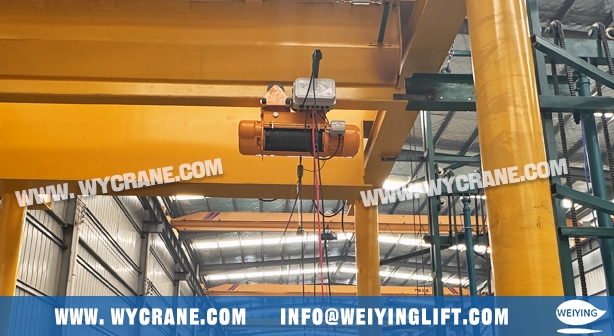
A single trolley hoist mounts one lifting mechanism (typically a single drum with one hook) on one trolley running along a single beam.
Advantages:
- Simple structure with fewer failure points
- Lighter self‑weight and lower wheel loads — easier on existing structures
- Lower purchase cost and faster installation
- Lower headroom requirements, maximizing hook approach
- Easier and cheaper maintenance, with simpler fault isolation
Limitations:
- One hook means limited capability for long or eccentric loads — a 12‑meter steel beam hung from one point needs extensive rigging and is inherently unstable
- Deflection and swing become noticeable on large spans
- A single failure in the hoist, brake, or rope can disable the entire crane
What Is a Double Trolley Wire Rope Hoist?
A double trolley system uses two trolleys or hoisting units working in coordination, typically on a double‑girder bridge.
Common configurations:
- Synchronized twin hoists: Two identical hoists sharing one load with electronic synchronization
- Main + auxiliary hook: One heavy‑duty main hoist plus a smaller auxiliary hoist for faster light work
- Linked trolleys: Mechanically or electronically linked trolleys designed for long‑load handling
Advantages:
- Two lifting points dramatically improve stability for long or flexible loads
- Load sharing reduces stress on the load itself — critical for fragile or assembled structures
- Redundancy: a properly designed system can land a load safely if one unit fails
- Dual hooks can rotate or position loads without chain falls or extra rigging
Trade‑offs:
- Higher purchase cost and installation complexity
- Roughly double the wheel loads — demanding stronger runways
- Sophisticated controls (encoders, VFDs, PLCs) requiring commissioning and periodic calibration
- Roughly double the maintenance points and spare parts inventory
Safety Comparison: Is a Double Trolley Always Safer?
Short answer: no. Proper selection, synchronization control, brake redundancy, and limit protection matter far more than the trolley count itself. A well‑specified single trolley with complete protective devices is safer than a poorly synchronized double trolley.
Where double trolleys genuinely help:
- Two independent lifting points provide physical redundancy
- Long loads are inherently more stable with two supports
- Designed systems allow a controlled, safe landing if one hoisting unit fails
Where double trolleys introduce new risk:
- Synchronization errors — hooks drifting apart in height tilts the load and shifts weight onto one hoist
- Uneven load sharing — in a tandem lift, one hook can carry 70–80% of the load even when both are “rated” for the total
- Speed mismatch between the two drives, especially near the ends of long travel
- Control logic failures — a PLC or encoder fault can command the two units in opposite directions
- Structural interference — two trolleys on one bridge need collision avoidance
Single trolley risks: a single lifting point is sensitive to off‑center loads, and deflection/swing increase with span. But the system itself is simpler, with fewer components that can fail.
Essential safety devices either way: overload protection, undervoltage protection, travel limits, anti‑two‑block protection, slack rope protection, synchronization deviation alarms, brake monitoring — and for outdoor or long‑span applications, wind speed measurement and anti‑sway control.
Operational Efficiency and Uptime
- Cycle time: Dual hooks can rotate and position a long load in one motion instead of two or three — but only with skilled operators and properly commissioned controls. A poorly tuned sync system is slower than one good operator with one hook.
- Downtime: Two trolleys provide redundancy against single‑point mechanical failures. However, the added sensors, drives, and electronics introduce new electronic failure modes that didn’t exist before.
- Flexibility: Single trolleys suit standardized, light‑to‑medium duty work with frequent load changes. Double trolleys reward fixed, repetitive heavy‑duty or long‑load processes.
- Energy: Not necessarily higher for the same load — but greater self‑weight and wheel loads increase travel resistance and can demand a larger building supply.
Which Configuration Should You Choose? A Decision Framework
Work through these five questions in order. Each answer eliminates one branch of the decision tree.
1. Is the load long, eccentric, or does it require two lifting points? A 10‑meter tube, an assembled machine frame, or any load whose center of gravity shifts during handling needs two points — lean toward a double trolley. Compact loads with a fixed, centered lifting point are well served by a single trolley.
2. Is a single‑point stoppage unacceptable? On a critical production line where one hour of downtime costs more than a year of maintenance, you need redundancy — either a double trolley system designed for safe single‑unit operation, or a standby single hoist. For general workshops, redundancy is usually cheaper bought as a spare hoist than as a second trolley.
3. Are headroom, wheel loads, or building structure constrained? Measure before you specify. A double trolley on an existing single‑girder bridge is usually impractical — the wheel loads and hook approach dimensions won’t work. In constrained buildings, a high‑spec single trolley is almost always the answer.
4. Do you have the controls and maintenance capability? Synchronized systems need commissioning, load calibration, and periodic verification — plus technicians who understand VFDs and encoders. If your maintenance team is small, choose a high‑spec single trolley rather than a low‑spec double trolley. Complexity you can’t maintain is risk you’ve bought, not capacity.
5. What does the total cost of ownership (TCO) say? Compare more than purchase price:
| Cost Item | Single Trolley | Double Trolley |
| Purchase + installation | Low | High |
| Structural reinforcement | Rarely needed | Often required |
| Inspection & certification | One set | Two sets + sync verification |
| Spare parts | Single inventory | Matched pairs |
| Expected downtime cost | Higher (single point) | Lower (with redundancy) |
| Energy over life | Lower | Moderately higher |
Verification before acceptance — whatever you choose: static and dynamic load tests per the applicable standard (EN 13155 / ASME B30), brake slip measurement at rated load, limit switch and overload protector function tests, and — for double trolleys — synchronization accuracy verification under full load.
Maintenance Complexity Comparison
| Item | Single Trolley | Double Trolley |
| Brakes / ropes / hooks | One set | Two sets — manage as matched pairs |
| Synchronization system | None or simple | Encoders / VFDs / PLC — periodic calibration |
| Fault isolation | Relatively easy | Must separate mechanical vs. electrical vs. sync errors |
| Spare parts | Few | Matched pairs, longer lead times |
| Annual inspection focus | Brakes, limits, ropes | All of the above + sync deviation, hook imbalance, wheel load differences |
Special Topic: Two Hoists Lifting the Same Object
Tandem lifting deserves its own rules, whether with a dedicated double trolley or two independent hoists:
- Never assume 50/50 load split. Rig so that each hoist stays below 75% of its rated capacity, and verify actual sharing with load cells at commissioning.
- Match rope lengths and hook heights so both connections engage simultaneously.
- One operator, one radio — tandem lifts must never have two people commanding.
- Test‑lift low, check level, and only proceed if tilt stays within your specified tolerance (commonly under 3° for most loads).
- Set absolute stop limits on both units before lifting; a drifting hook has no second chance.
Key Specs to Confirm Before Buying
- Capacity, duty class (FEM/ISO), lifting height, span, and speeds
- Control method, IP rating, and explosion protection rating (ATEX) if applicable
- Wheel loads, maximum wheel load, and rail type compatibility — for both trolleys if double
- Hook spacing / minimum distance between hooks (double trolley)
- Required synchronization accuracy and how it’s measured
- Brake type, quantity, and redundancy design
- Full safety device list; encoder and communication brands
- Spare parts availability; certification and load test reports
FAQ
Is a double trolley hoist always safer than a single trolley?
No. Synchronization quality, load sharing, and protective devices determine safety more than trolley count. A well‑specified single trolley with full protection is safer than a poorly synchronized double trolley.
Can a single‑girder crane use a double trolley?
It’s uncommon — wheel loads, structural strength, and hook approach dimensions usually rule it out. Double trolleys are typically paired with double‑girder bridges. Consult a structural assessment before considering it.
What should I watch when two hoists lift the same object?
Load distribution (never assume 50/50), matched rope lengths, synchronized speeds, one designated operator, and absolute stop limits on both units. See the tandem lifting section above.
What synchronization accuracy is typically required?
It depends on load geometry and allowable tilt — commonly a few millimeters of hook height difference under rated load. Confirm the value with your supplier and verify it at commissioning and every periodic inspection.
Can an existing plant be upgraded to a double trolley system?
First check runway and bridge capacity against the new wheel loads, available headroom, and rail condition. A structural assessment comes before any equipment decision — reinforcement often costs more than the hoists themselves.
About us
With 34 years of manufacturing experience and 12 years of export expertise, we have built a dual advantage of professional qualifications and a global presence. Our business covers more than 100 countries and regions across Asia, Europe, the Americas, Africa, and Oceania. We are certified under the ISO management system and hold CE product certifications. Our main product lines include six major series—electric hoists, electric winches, gantry cranes, bridge cranes, marine cranes, and portal cranes—comprising nearly 100 different models.
If you want to learn more, please contact us.