If you need to lift, position, or move heavy items within a fixed area — a machine station, a loading bay, a workbench — a jib crane is often the most practical and cost-effective solution ever built.
Unlike overhead bridge cranes that span entire workshops, jib cranes concentrate lifting power exactly where the work happens. That makes them the default choice for workstation lifting: fast to install, cheap to run, and always available — no waiting for a shared crane to finish its current job.
This guide covers the six most common jib crane applications in industry, explains why each scenario suits a jib crane (and where it doesn’t), and shows you how to decide between a jib crane and an overhead crane for your facility.
What Is a Jib Crane?
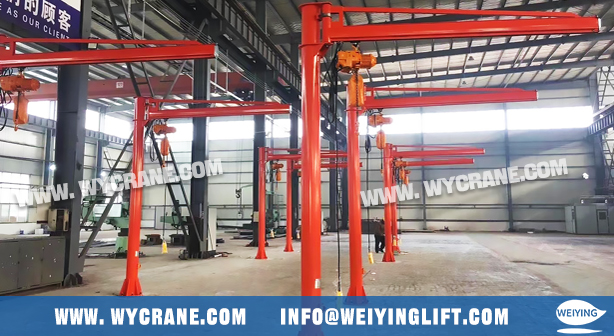
A jib crane consists of a horizontal arm (the “jib” or boom) mounted to a support — a floor-mounted column or a building wall — with a hoist (electric chain, wire rope, or manual) traveling along the arm. The arm rotates, giving the crane a fan-shaped or circular coverage area around its support point.
The four main types:
-
Floor-mounted jib crane — the most common. A column anchored to a concrete foundation, offering up to 360° rotation. Capacities from 0.25t to over 10t.
-
Wall-mounted jib crane — bolted to an existing column or wall. Saves floor space, typically 180–200° rotation, lower capacities.
-
Articulating jib crane — a two-section folding arm that navigates around obstacles (machine guards, tools) and allows precise load positioning in tight spaces.
-
Mast-type jib crane — supported at top and bottom without a massive foundation, ideal where floor excavation isn’t possible.
Key specifications to keep in mind: capacity, arm length (reach), rotation angle, lift height, and the load curve — remember that allowable load typically decreases toward the tip of the arm.
Why Jib Cranes Dominate Workstation Lifting
Before diving into applications, it helps to understand the structural advantage:
-
Low investment — no runway beams, no building columns, no long tracks. A single foundation (or none, for wall-mounted units) is enough.
-
Fast installation — most units are installed over a weekend without stopping production.
-
Zero waiting time — the hook lives directly above the workstation. One operator completes the entire pick–position–place cycle alone.
-
Simple operation — rotation plus hoist travel is intuitive; minimal training required.
-
Compact footprint — frees up floor space compared to forklifts or gantry systems.
The honest limitations: jib cranes cover a fixed, local area. They cannot transport loads across a workshop, and very long reaches or very heavy capacities (beyond ~5–10t) usually push you toward other solutions. Keep that in mind as we walk through the applications.
Application 1: Machine Tool Loading & Unloading
This is the single most common jib crane application in manufacturing.
Typical scenarios:
-
Loading raw blanks and unloading finished parts from CNC machining centers, lathes, mills, and grinders
-
Handling heavy workpieces, fixtures, and molds at press brakes and injection molding machines
-
Changing chucks, vises, and tooling on machine tables
Why a jib crane fits perfectly: Machine tools are fixed assets. The loading point never moves, the work envelope is typically 3–6 meters, and cycle frequency is high — every part loaded and unloaded is one crane cycle. A jib crane parked beside the machine eliminates the biggest hidden cost in machine shops: waiting for the shared overhead crane while the spindle sits idle. Cycle studies consistently show loading time dropping from several minutes to under one when a dedicated jib is installed.
Articulating jibs deserve special mention here: the folding arm swings around machine guards, tool changers, and enclosures to place parts precisely onto the chuck or worktable — something a straight boom can’t do.
Selection tips: Size the arm to cover the machine table plus the parts bin or pallet position. Choose electric rotation and variable-speed hoisting for cycles above ~10 lifts/hour. Always confirm clearance with the machine’s enclosure in its most open position.
Boundary case: if multiple machines share one loading point, or the crane must serve machines on both sides of an aisle, a jib’s coverage won’t reach — that’s bridge crane territory.
Application 2: Assembly Workstations
From pump assembly to electrical cabinet wiring, thousands of assembly tasks involve parts too heavy to hold comfortably but too precise to slam into place.
Typical scenarios:
-
Positioning motors, gearboxes, pumps, and casings onto bases and frames
-
Aligning bolt holes and flanges during subassembly
-
Holding a component in position while operators fasten it
Why a jib crane fits perfectly: Assembly rarely involves traveling — it involves holding a 50–200 kg component in exactly the right orientation, sometimes for minutes. A jib crane with a suitable hoist turns “three operators wrestling a pump casing” into “one operator guiding a suspended load with fingertip control.”
For high-precision work, pair the jib with a pneumatic balancer or intelligent lifting device: the load “floats” and follows the operator’s hand, making flange and bolt-hole alignment almost effortless.
Boundary case: if the assembly line itself moves — overhead conveyor, moving pallet system — the jib is the wrong tool. You need equipment that travels with the line (KBK light crane systems or an overhead crane).
Application 3: Warehouses & Storage Areas
Warehouses are shared territory — some zones belong to the jib crane, some don’t.
Where jib cranes work:
-
Fixed loading/receiving docks — lifting goods between truck bed and dock conveyor or pallet position
-
Mold and die storage — a single, high-value, high-frequency pick point
-
Shelving rows and parts counters — wall-mounted jibs along a fixed rack line
-
Packing and dispatch stations — positioning heavy items into crates or onto pallets
-
Dead corners — areas at the end of a building or beside doorways that the overhead crane simply cannot reach; a jib is the standard “coverage patch”
Where they don’t: Long-distance put-away, full-pallet stacking, and high-frequency pallet flow belong to forklifts, stackers, or stacker cranes. A jib crane is a point tool, not a warehouse logistics system — using one for general pallet movement wastes its precision and its capacity for value-added work.
Configuration tips: Wall-mounted units are ideal along fixed rack lines (no floor obstruction). For outdoor yards, specify weatherproof hoists, outdoor-duty paint systems, and check wind loading on the arm.
Application 4: Maintenance & Repair Workshops
Every maintenance bay has the same pattern: components arrive broken, get torn down, and leave rebuilt — all within a few square meters.
Typical scenarios:
-
Removing and reinstalling motors, gearboxes, pumps, and compressors
-
Engine and drivetrain work in vehicle and equipment shops
-
Hoisting parts out of machine frames during breakdown repairs
Why a jib crane fits perfectly: Repair work is random in timing but fixed in location. A jib crane stands ready 24/7, needs no floor tracks (so forklifts and parts carts pass freely), and at 0.5–2t covers the overwhelming majority of maintenance components. Electric shops especially benefit: no emissions, no floor space consumed, instant availability for emergency breakdowns.
Bonus: many shops weld a tool tray or work light to the jib column, turning it into a complete workstation.
Application 5: Production Lines
On production lines, the jib crane’s role depends entirely on one question: is the lifting a point or a line?
Where jib cranes work — “point” lifting:
-
Individual stations that need frequent local hoisting (fitting heavy components onto the product)
-
Loading and unloading buffer positions
-
Die and tooling changes at presses and molding machines
-
Feeding heavy parts into a station without interrupting the line’s main flow
The distributed pattern: instead of one shared overhead crane serving ten stations (with every station waiting), smart plants install one jib crane per station. The overhead crane handles long-distance “trunk” transport between areas; each jib handles its own “last meter.” Queuing disappears.
Where they don’t — “line” lifting: If the load must travel along the production line — hanging parts moving station to station, or a hoist tracking a moving product — you need a KBK light crane system, a monorail, or an overhead crane.
Decision rule of thumb: fixed workstation = jib; continuous flow = traveling crane system.
Application 6: Loading & Unloading Areas
Loading bays look simple but involve vehicles, height differences, and depth into truck bodies.
Where jib cranes work:
-
Fixed indoor dock positions — a floor-mounted jib can be sized so its arm reaches deep into a truck bed, placing loads precisely (a forklift can’t place gently, and a crane hook from above often can)
-
Hoppers and bulk containers — controlled tipping and positioning of material bins
-
Building-edge zones the overhead crane can’t cover
Where they don’t: Open-yard multi-truck operations with fast pallet flow need forklifts or mobile gantries. If the lifting point moves with each vehicle or each load, a fixed jib fights you instead of helping you.
Engineering cautions for dock applications: check arm clearance against the tallest vehicle roofline, wind load on outdoor units, and vehicle restraint so a truck can’t pull away under a loaded arm.
Jib Crane vs Overhead Crane: Which One for Your Scenario?
This is the comparison buyers actually need — because the wrong choice costs money for a decade.
| Decision Factor |
Choose a Jib Crane |
Choose an Overhead Crane |
| Lifting zone |
Fixed point, fan-shaped area |
Whole bay, cross-workshop transport |
| Number of stations |
1–2 fixed stations |
Many stations sharing one crane |
| Travel distance |
Short (<10 m), localized |
Long, cross-area transport |
| Capacity / span |
0.25–5t typical, arms ≤7 m |
Heavy capacity, large spans |
| Building requirements |
Small foundation or wall only |
Runway beams, columns, building structure |
| Investment |
Low, per-station |
High, system-wide |
| Waiting time |
None (dedicated) |
Shared — queuing possible |
| Cycle pattern |
High-frequency, short cycles |
Lower-frequency, bulk moves |
The one-sentence rule: if the lifting is a point operation, choose a jib crane; if it’s a line or area operation, choose an overhead crane.
And the hybrid insight worth remembering: jib cranes and bridge cranes are complements, not competitors. Bridge cranes form the trunk routes; jib cranes form the last-meter delivery to each workstation. Plants that combine both consistently report the shortest overall handling times.
How to Choose the Right Jib Crane for Your Application
-
Capacity — heaviest load plus lifting device, plus a 20% margin.
-
Arm length — must cover load pickup, machine/workstation, and set-down points. Critical: check the load-at-radius curve — a 2t crane rated at the column may only lift 0.8t at full arm extension.
-
Rotation — 360° floor-mounted vs 180°+ wall-mounted; match to the actual work envelope.
-
Hoist type — manual for rare light lifts; electric for frequent cycles; pneumatic for explosive or clean environments; intelligent lifters for precision assembly.
-
Rotation drive — manual rotation for infrequent use, electric for high-cycle workstations (reduces operator fatigue dramatically).
-
Installation conditions — foundation bearing capacity for floor-mounted units; wall/column structural strength for wall-mounted; headroom and obstruction checks.
-
Environment — explosion-proof (ATEX), cleanroom, outdoor, or low-temperature versions where required.
Conclusion
Jib cranes earn their place wherever lifting happens at a fixed point, at high frequency, and within a tight radius. Machine tool loading, assembly workstations, mold storage, maintenance bays, station-level production lifting, and fixed dock positions all share this signature — and in all of them, a jib crane delivers what shared equipment cannot: zero waiting time, single-operator convenience, and a fraction of the investment of an overhead system.
Get the three fundamentals right — capacity at full arm extension, arm length covering pickup-to-set-down, and rotation matching the work envelope — and a jib crane will quietly outwork equipment costing ten times more.
FAQ
What is the difference between a jib crane and an overhead crane? A jib crane serves a fixed, fan-shaped area around one support point, while an overhead crane travels on runway beams to cover an entire bay or workshop. Jib cranes suit dedicated workstation lifting; overhead cranes suit shared, long-distance transport.
What capacity jib crane do I need for machine loading? Size it for the heaviest workpiece plus fixture or lifting device, plus a 20% margin — and always check the capacity at your required arm length, not just the maximum headline capacity.
Can a jib crane rotate 360 degrees? Floor-mounted jib cranes typically rotate a full 360°. Wall-mounted units are limited by the building, usually 180–200°.
Can I install a jib crane without a foundation? Yes — wall-mounted jibs bolt to existing structural columns, and mast-type jibs use top and bottom bracing instead of a deep foundation. Articulating jibs are also available in column-mounted styles with modest base requirements.
Is a jib crane better than a forklift for loading and unloading? At a fixed dock position with repeated lifts, usually yes: precise placement, no floor congestion, no fuel, and no operator certification bottleneck. For moving vehicles and scattered loads across a yard, the forklift wins.
How many jib cranes do I need on a production line? One per lifting station is the ideal pattern. If stations are within one arm’s reach of each other, one unit can cover two; if lifting points are spread along the line’s direction, a traveling crane system is more economical than multiple jibs.
About us

With 34 years of manufacturing experience and 12 years of export expertise, we have built a dual advantage of professional qualifications and a global presence. Our business covers more than 100 countries and regions across Asia, Europe, the Americas, Africa, and Oceania. We are certified under the ISO management system and hold CE product certifications. Our main product lines include six major series—electric hoists, electric winches, gantry cranes, bridge cranes, marine cranes, and portal cranes—comprising nearly 100 different models.
If you want to learn more, please contact us.