In modern ports, container terminals, railway freight yards, and logistics centers, Rubber Tyred Gantry Cranes (RTG) and Rail Mounted Gantry Cranes (RMG) are the two most widely used container handling solutions.
Although both are gantry cranes designed for stacking and moving containers, they differ significantly in mobility, infrastructure requirements, operating efficiency, investment costs, and ideal applications.
Choosing between an RTG and an RMG can have a major impact on yard productivity, operational flexibility, and long-term operating costs.
This guide explains the differences between RTG vs RMG, compares their advantages and disadvantages, and helps terminal operators select the right solution for their container handling operations.
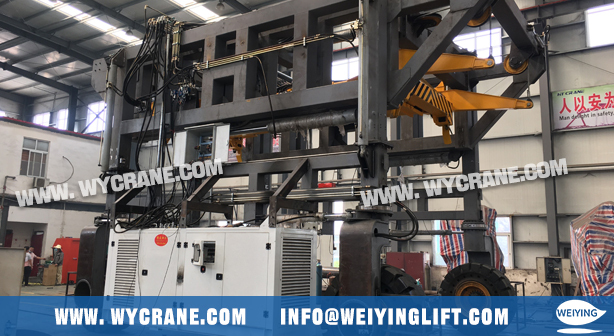
A Rubber Tyred Gantry Crane (RTG) is a gantry crane that travels on rubber tires instead of fixed rails.
RTGs are commonly used in:
Their main advantage is mobility. Since they do not require rails, RTGs can move between different container blocks and adapt to changing yard layouts.
A Rail Mounted Gantry Crane (RMG) travels on fixed rails installed along container storage lanes.
RMGs are commonly used in:
Because the crane follows a fixed rail path, it offers superior precision, automation capability, and stacking efficiency.
| Feature | RTG Crane | RMG Crane |
| Travel System | Rubber tires | Steel rails |
| Mobility | High | Fixed path |
| Infrastructure Cost | Lower | Higher |
| Yard Flexibility | Excellent | Limited |
| Automation Capability | Moderate | Excellent |
| Stacking Density | Medium | High |
| Energy Efficiency | Medium | High |
| Maintenance Cost | Tire maintenance required | Rail maintenance required |
| Expansion Flexibility | Easy | Difficult |
| Suitable for Automation | Limited | Ideal |
The biggest difference between RTG and RMG cranes is mobility.
RTGs can move freely between container blocks.
Benefits include:
This makes RTGs especially attractive for growing terminals where storage layouts may change over time.
RMGs are restricted to rail tracks.
While this reduces flexibility, it provides:
RTGs do not require rail installation.
This results in:
RMG systems require:
Initial investment is therefore significantly higher.
Storage density is critical for modern terminals.
RTGs generally require wider travel lanes and safety clearances.
As a result:
RMGs operate within fixed lanes.
Benefits include:
With the rise of automated container terminals, automation capability has become increasingly important.
Modern RTGs can support:
However, full automation remains more complex due to free movement.
RMGs are considered the preferred solution for:
Because their travel path is fixed, automation is easier and more reliable.
Traditional RTGs often use diesel generators.
Although electric RTGs are becoming more common, energy consumption is generally higher.
RMGs are usually powered directly through electrical systems.
Advantages include:
Common maintenance items include:
Typical maintenance focuses on:
Maintenance complexity varies depending on operating conditions.
An RTG crane is usually the better choice when:
✓ Terminal layouts frequently change
✓ Future expansion is expected
✓ Infrastructure budget is limited
✓ Operational flexibility is important
✓ Full automation is not required
Common applications include:
An RMG crane is usually the better choice when:
✓ Maximum storage density is required
✓ Terminal automation is planned
✓ Long-term operating efficiency is critical
✓ Land costs are high
✓ High-volume container handling is expected
Common applications include:
There is no universal winner.
The best choice depends on operational priorities.
For modern large-scale container terminals, RMG cranes are increasingly becoming the preferred solution due to their automation capability and superior storage efficiency. However, RTGs remain highly popular because of their flexibility and lower infrastructure requirements.
Neither crane is universally better; the choice depends on operational requirements.
Large automated container terminals generally prefer RMG systems, while many medium-sized ports and inland depots continue to use RTGs.
RMG cranes generally provide higher stacking density because they operate on fixed lanes and require less operational clearance. This allows terminals to maximize land utilization and store more containers within the same yard area.
In the long term, RMG cranes often have lower operating costs due to their electric power supply, higher efficiency, and reduced energy consumption. However, actual costs depend on terminal size, operating hours, local energy prices, and maintenance practices.

With 34 years of manufacturing experience and 12 years of export expertise, we have built a dual advantage of professional qualifications and a global presence. Our business covers more than 100 countries and regions across Asia, Europe, the Americas, Africa, and Oceania. We are certified under the ISO management system and hold CE product certifications. Our main product lines include six major series—electric hoists, electric winches, gantry cranes, bridge cranes, marine cranes, and portal cranes—comprising nearly 100 different models.
If you want to learn more, please contact us.
E-mail address: info@weiyinglift.com
Website: www.wycrane.com