When selecting a gantry crane for workshops, warehouses, construction sites, or manufacturing facilities, one of the most common questions buyers ask is:
Should I choose a portable gantry crane or a fixed gantry crane?
Although both types belong to the gantry crane family and serve the same basic purpose—lifting and moving heavy loads—they differ significantly in mobility, installation requirements, load capacity, flexibility, and long-term operating costs.
This guide compares portable gantry cranes and fixed gantry cranes from multiple perspectives to help you determine which solution best suits your application.
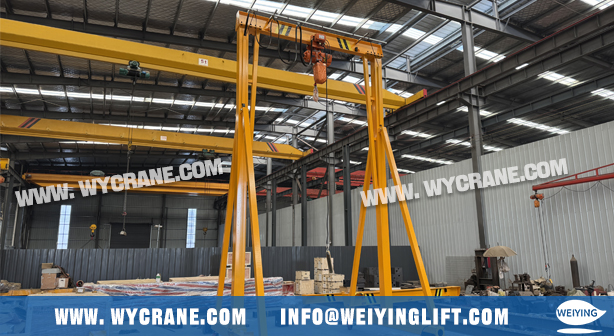
A portable gantry crane is a lightweight, movable lifting system designed for temporary or flexible lifting operations. It typically consists of:
The entire structure can be moved to different work areas without dismantling, making it ideal for facilities where lifting locations frequently change.
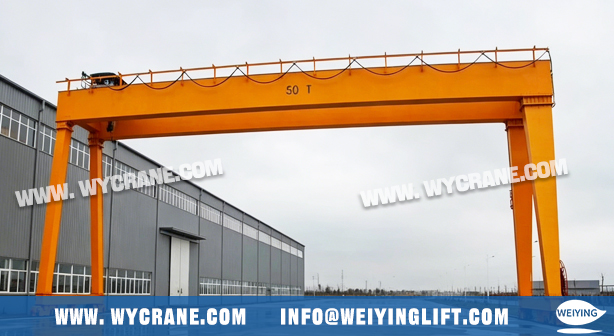
A fixed gantry crane is a permanently installed lifting system that operates on a designated track, rail, or fixed work area. Unlike portable models, it is designed for continuous industrial operations and heavy-duty lifting tasks.
Fixed gantry cranes are commonly found in:
Typical capacities range from 5 tons to over 100 tons depending on the application.
| Factor | Portable Gantry Crane | Fixed Gantry Crane |
| Mobility | Excellent | Limited |
| Installation | Quick and simple | Requires foundation and installation |
| Load Capacity | Usually 0.5–10 tons | 5–100+ tons |
| Span Length | Small to medium | Medium to very large |
| Stability | Moderate | Excellent |
| Lifting Frequency | Occasional to moderate | Continuous heavy-duty operation |
| Relocation | Easy | Difficult |
| Initial Investment | Lower | Higher |
| Maintenance Cost | Lower | Moderate |
| Service Life | 5–15 years | 15–30+ years |
| Customization | Limited | Extensive |
Load capacity is often the most important factor when choosing between the two types.
Portable models are designed for lighter loads and occasional lifting operations.
Common capacities include:
Because portability is a priority, the structure must remain relatively lightweight.
Fixed gantry cranes are engineered for demanding industrial environments.
Common capacities include:
Their rigid structure provides greater safety and stability when handling large loads.
The biggest advantage of a portable gantry crane is mobility.
Users can:
This flexibility is particularly valuable for maintenance departments and repair workshops.
Fixed gantry cranes sacrifice mobility in exchange for higher efficiency.
Advantages include:
For production lines with repetitive lifting tasks, fixed systems usually deliver better performance.
Installation is straightforward:
Most portable gantry cranes require no foundation work.
Installation is more complex and often requires:
Although the initial setup takes longer, the result is a more stable and durable lifting solution.
Portable gantry cranes are best suited for environments where flexibility and mobility are critical.
Maintenance and Service Departments:Ideal for lifting motors, pumps, compressors, and other equipment during inspection, repair, or replacement.
Multi-Station Workshops:Suitable for facilities where lifting tasks occur at different locations and a fixed lifting system would be underutilized.
Equipment Installation and Assembly:Useful for positioning machinery, production equipment, and components during installation projects.
Rental and Temporary Projects:A practical solution for short-term construction, shutdown maintenance, or project-based lifting requirements.
Warehouses and Logistics Centers:Effective for occasional loading, unloading, and handling of heavy goods without investing in permanent crane infrastructure.
Fixed gantry cranes are designed for high-volume, repetitive, and heavy-duty lifting operations.
Manufacturing Production Lines:Ideal for continuous movement of raw materials, workpieces, and finished products throughout the production process.
Steel and Metal Fabrication Plants:Suitable for handling large steel structures, plates, pipes, and fabricated assemblies.
Shipbuilding and Marine Facilities:Used for lifting heavy ship sections, engines, and oversized marine components.
Ports and Container Handling Areas:Efficient for moving containers, cargo, and heavy equipment across designated operating zones.
Precast Concrete and Heavy Industry:Well-suited for transporting molds, beams, concrete panels, and other large industrial products on a daily basis.
Before purchasing, answer the following questions:
| Question | Portable | Fixed |
| Do lifting locations change frequently? | ✓ | |
| Is mobility important? | ✓ | |
| Are loads below 10 tons? | ✓ | |
| Is the project temporary? | ✓ | |
| Is continuous operation required? | ✓ | |
| Are loads above 10 tons? | ✓ | |
| Is maximum stability required? | ✓ | |
| Is long-term productivity the priority? | ✓ |
The option with the most checkmarks usually represents the better choice.
Neither a portable gantry crane nor a fixed gantry crane is universally better—the right choice depends entirely on your operational requirements.
A portable gantry crane offers unmatched flexibility, quick deployment, and lower upfront costs, making it ideal for maintenance work, multi-purpose workshops, equipment installation, and temporary projects.
A fixed gantry crane provides superior lifting capacity, structural stability, and long-term productivity, making it the preferred solution for manufacturing plants, shipyards, steel fabrication facilities, ports, and other heavy-duty industrial applications.
Before making a purchase decision, carefully evaluate your load capacity, workspace layout, lifting frequency, mobility requirements, budget, and future expansion plans. Selecting the correct gantry crane today can significantly improve safety, efficiency, and return on investment for years to come.
Portable gantry cranes can handle many industrial lifting tasks, typically ranging from 0.5 to 10 tons. However, for continuous heavy-duty operations or loads exceeding 10 tons, a fixed gantry crane is usually the better choice.
Both can be safe when properly designed and operated. However, fixed gantry cranes generally offer greater structural stability and are better suited for handling heavy loads in demanding industrial environments.
Portable gantry cranes typically have much lower installation costs because they usually require no rails, foundations, or complex infrastructure.

With 34 years of manufacturing experience and 12 years of export expertise, we have built a dual advantage of professional qualifications and a global presence. Our business covers more than 100 countries and regions across Asia, Europe, the Americas, Africa, and Oceania. We are certified under the ISO management system and hold CE product certifications. Our main product lines include six major series—electric hoists, electric winches, gantry cranes, bridge cranes, marine cranes, and portal cranes—comprising nearly 100 different models.
If you want to learn more, please contact us.
E-mail address: info@weiyinglift.com
Website: www.wycrane.com