

Understanding Jib Crane Hazards
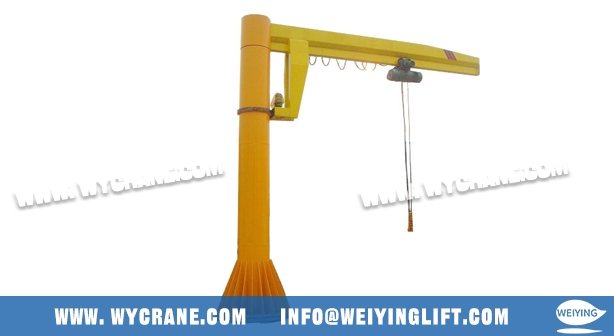
Overloading. Exceeding the rated capacity is the leading cause of crane failures. It usually happens in one of two ways: operators estimate the load weight instead of confirming it, or they forget that slings, shackles, and lifting beams all count toward the total load on the hook.
Side pulling. A jib crane is designed to lift vertically. If the hook isn’t directly above the load’s center of gravity, the operator may be tempted to drag the load toward the hook. This “side pull” creates horizontal forces the crane was never designed for, overstressing the arm, bearings, and hoist—and it is one of the most common causes of structural failure, even when the load itself is well under capacity.
Equipment defects. Worn wire ropes, cracked hooks, failing brakes, and loose anchor bolts rarely fail without warning. Warning signs are usually visible weeks in advance—if anyone looks.
Load swing. Sudden starts and stops set the load pendulum in motion. A swinging load can strike workers, racking, or the crane structure itself. The heavier the load, the more energy that swing carries.
Human factors. Unauthorized operation, standing under suspended loads, guiding loads by hand, and poor communication during multi-person lifts remain persistent causes of serious injury. Fatigue and distraction multiply every other risk on this list.
Environmental hazards. Overhead cranes, forklifts, and pedestrians crossing the jib’s rotation radius; poor lighting; cluttered floors; and wind for outdoor or open-door units all add risk that has nothing to do with the machine itself.
Pre-Operation Safety Checks
Visual inspection
- Check the column, arm, welds, and anchor bolts for cracks, deformation, corrosion, or looseness
- Inspect wire rope or chain for broken wires, kinks, flattening, corrosion, and lubrication
- Examine the hook: throat opening, cracks, swivel function, and the safety latch—an unlatched hook is a dropped load waiting to happen
- Verify all load rating labels are legible
Function test (no load)
- Raise and lower the hook through its full travel, testing the brake at several points—it should hold the hook stationary wherever it stops
- Rotate the arm through its full range; motion should be smooth, without binding, unusual noise, or play in the bearings
- Test upper and lower limit switches, then the emergency stop
Work area verification
- Keep the entire swing radius clear of people and obstructions
- Confirm adequate lighting and a clear line of sight to the load path
- Verify the floor is free of tripping hazards and that the load’s destination is ready
Load assessment
- Confirm the load weight from documentation, a scale, or the supplier—never guess
- Identify the center of gravity and attach slings accordingly
- Verify the combined weight of load plus rigging stays within the crane’s rated capacity
Safe Operation: Step by Step
Confirm authorization and signals. Only trained, authorized operators may run the crane. For any lift involving more than one ground worker, designate a single signal person; the operator follows that person’s signals and no one else’s.
Rig the load correctly. Attach slings above the load’s center of gravity, protecting them from sharp edges with padding or corner protectors. Raise the load slowly 10–20 cm and pause: check balance, brake holding, and that nothing snags. If anything looks wrong, lower and re-rig. This brief “test lift” is the last checkpoint before the real lift begins.
Lift and rotate smoothly. Raise the load only high enough to clear obstacles. Rotate slowly and steadily—no abrupt starts or stops. Use tag lines to manage swing, and keep the load as low as practical throughout the move.
Lower and release. Position the load directly over its landing point, lower slowly, and confirm it is fully supported and stable before releasing tension and removing slings. Never pull slings out from under a load that isn’t resting securely.
- Never exceed the rated capacity
- Never side-pull or drag a load horizontally toward the hook
- Never lift people or allow anyone under a suspended load
- Never guide a load with your hands on it
- Never leave a suspended load unattended
- Never operate with known defects or bypassed safety devices
- Never use the crane in winds beyond the manufacturer’s limit
- Never operate when fatigued, distracted, or under medication affecting alertness
Sling and Rigging Basics
- Inspect every sling before each use; remove damaged slings from service immediately and destroy them so they can’t be reused
- Remember that sling angle reduces capacity—at 45°, a two-leg bridle loses roughly 30% of its rated capacity; at 30°, nearly half
- Use shackles and hooks with working load limits marked and legible; never force an oversized hook into a small shackle
- Pad sharp corners; never twist, knot, or shorten slings by knotting
- Use a lifting beam or spreader for long, flexible loads that would crush under their own weight
Maintenance and Inspection Schedule
| Maintenance Tier | Owner | Scope |
|---|---|---|
| Daily / Pre-shift | Operator | The visual and function checks described above: structure, wire rope or chain, hook and safety latch, load rating labels; raise/lower with brake test, full rotation, limit switches and emergency stop. |
| Monthly | Maintenance staff | Re-torque anchor bolts per spec, lubricate the rotation bearing, hoist gears, and wire rope, check brake pad wear, inspect electrical connections and pendant or remote controls. |
| Annual / Periodic | Qualified person | Structural examination including weld inspection, arm deflection measurement, insulation and grounding tests, and load testing per applicable standards. |
Training and Compliance
- New operators complete classroom + hands-on training and pass a practical evaluation before their first solo lift
- Training is refreshed regularly and after any incident or equipment change
- Inspection records are kept and auditable
Emergency Procedures
- Know the emergency stop—its location, and when to use it
- Power failure with a suspended load: keep people clear, do not attempt to move the load manually, restore power or follow the manufacturer’s recovery procedure
- Uncontrolled load or crane movement: alert everyone in the radius, hit the e-stop, and evacuate the swing path
- After any incident: make the crane safe, report it, and have the unit inspected before returning it to service
Conclusion
FAQ
Do I need a license to operate a jib crane?
How often should a jib crane be inspected?
When should outdoor operation stop due to wind?
About us

With 34 years of manufacturing experience and 12 years of export expertise, we have built a dual advantage of professional qualifications and a global presence. Our business covers more than 100 countries and regions across Asia, Europe, the Americas, Africa, and Oceania. We are certified under the ISO management system and hold CE product certifications. Our main product lines include six major series—electric hoists, electric winches, gantry cranes, bridge cranes, marine cranes, and portal cranes—comprising nearly 100 different models.
If you want to learn more, please contact us.