When buyers specify a jib crane, they obsess over load capacity and boom length. Yet the rotation angle is the specification that ultimately determines whether the crane actually reaches every load point—or swings directly into a wall. The wrong jib crane rotation angle creates collision hazards, wastes capital, and leaves operators manually handling materials the crane was supposed to lift. This guide explains the fundamentals of jib crane rotation, why it often matters more than lifting performance, and how to choose between 270° and 360° for your specific layout.
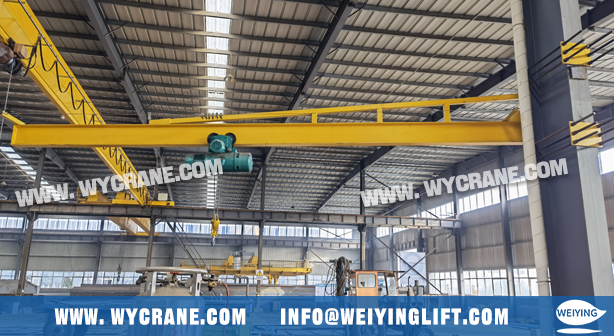
Jib crane rotation refers to the horizontal arc through which the boom (jib arm) swings around its vertical pivot. This movement is enabled by a slewing bearing assembly—typically a gear ring driven by an electric motor and pinion. Rotation limiters, either mechanical stops or electronic sensors, define the maximum allowable swing to prevent structural damage or collisions.
The three standard jib crane rotation angles are:
This rotation arc directly defines the crane’s work envelope—the actual floor area the hook can access. For a 360° crane, the envelope is a full circle (πr²). For 270°, it is exactly three‑quarters of that area. Specifying the wrong angle means paying for coverage you cannot use, or worse, discovering too late that a critical load point sits outside the reachable arc.
It sounds counterintuitive, but jib crane rotation often determines operational success more than lifting capacity. A 10‑ton crane that cannot reach the load is functionally useless, while a properly rotated 2‑ton crane that covers every required point keeps production flowing.
Vertical lifting is only half the material handling equation. Horizontal positioning—getting the load from point A to point B across the workshop floor—is where most time is spent and where most errors occur. If your jib crane swing angle does not encompass every pickup and drop‑off location, operators resort to manual dragging, forklifts, or dangerous rigging extensions. The rotation arc is what transforms a crane from a lifting tool into a true material handling solution.
Every unnecessary degree of rotation adds seconds to each lift cycle. Over thousands of repetitions, this compounds into hours of lost productivity. Conversely, a 360° crane in a tight space forces operators to swing loads through blind spots behind the workstation, increasing collision risk with walls, adjacent equipment, or personnel. A 270° partial rotation jib crane eliminates that rear blind arc entirely, keeping the boom in the operator’s forward field of view and reducing the likelihood of impacts.
There is also a mechanical cost to excessive rotation. 360° jib cranes require continuous collector rings to transfer power through the rotating joint, heavier slewing drives, and more robust bearings. These components add initial cost and ongoing maintenance complexity. 270° systems use simpler limit switches and smaller drives, delivering lower capital expense and reduced long‑term upkeep.
Selecting the correct jib crane rotation angle requires analyzing your physical environment and workflow, not defaulting to the maximum available specification.
The crane’s location relative to walls, aisles, and equipment is the primary determinant. A crane mounted in the center of an open bay can justify 360° rotation because there are no obstructions in any direction. A crane installed 2 meters from a building wall should almost never be specified as 360°—the rear 90° of rotation would point directly into concrete, rendering that arc both unusable and hazardous.
Overhead bridge cranes, building columns, ventilation ducts, and adjacent machinery all intrude into the theoretical rotation circle. Before specifying an angle, measure the minimum safe distance from the pivot point to every obstruction in all directions. If any obstruction falls within the rotation radius, the arc must be limited. A 270° jib crane requires only a three‑quarter circular clearance zone, making it far easier to fit into congested workshops.
Map every point the crane must service. Are your pickup and drop‑off locations distributed around the full 360° perimeter of the workstation? Or are they concentrated in a 200° arc facing the aisle? Most wall‑adjacent workstations never require access to the rear quadrant. Specifying 360° for a 240° workflow is paying for 50% more mechanical complexity to cover the 25% of space you will never use.
The price gap between 270° and 360° systems is not merely the cost of a larger bearing. Full‑rotation systems require more sophisticated electrification, heavier foundations to resist overturning moments in all directions, and more expensive limiter systems. For intermittent‑duty applications, a 270° manual rotation system may cost 30–40% less than its 360° motorized equivalent while delivering identical practical coverage.
Use this decision matrix to match your application to the correct jib crane rotation angle:
| Scenario | Recommended Rotation | Reasoning |
|---|---|---|
| Central workstation, completely open floor | 360° | No obstructions; full coverage maximizes flexibility |
| Near a wall, facing an aisle or work area | 270° | Rear 90° points into the wall; 270° covers all active zones |
| Along a linear production line | 270° | Linear layout never requires rear‑arc access |
| Outdoor yard with variable approach angles | 360° | Maximum flexibility for unpredictable truck and load positions |
| Tight workshop with adjacent equipment | 270° | Eliminates collision risk on the blind rear side |
| Multi‑crane bay (cranes installed close together) | 270° | Prevents boom interference between neighboring units |
| Circular assembly table or machine cluster | 360° | Load points surround the pivot; full rotation is essential |
The most expensive mistake in jib crane rotation selection is specifying 360° “just to be safe.” Buyers routinely pay the premium for full rotation without verifying whether the rear 90° arc is actually usable. The result is a crane with an oversized slewing mechanism, a larger foundation, and increased collision exposure—all to service a quadrant of the workshop that contains nothing but a concrete wall. Before defaulting to 360°, map your floor plan. If your active load points span 270° or less, that is the angle you should specify.
360° jib cranes are the right choice for open‑floor environments where loads approach from unpredictable directions. CNC machine clusters arranged around a central pillar, circular assembly stations with operators working on all sides, outdoor material yards with variable truck positions, and maintenance bays servicing equipment from multiple angles all benefit from full rotation. In these applications, limiting the arc would create genuine operational dead zones.
270° jib cranes are the practical standard for the majority of indoor industrial applications. Wall‑adjacent workstations, linear production and welding lines, loading docks, and narrow‑aisle warehouses rarely require rear‑arc access. By eliminating the unused 90°, these systems reduce collision risk, lower mechanical complexity, and cost significantly less than full‑rotation equivalents. When multiple jib cranes are installed in proximity, specifying 270° for each unit prevents boom‑to‑boom interference—a common hazard in crowded fabrication shops.
The debate between 270° vs 360° jib crane rotation is not about which angle is superior—it is about which angle matches your actual work envelope. For the majority of wall‑adjacent and linear‑layout workstations, 270° delivers complete functional coverage at lower cost and higher safety. Reserve 360° for truly open‑floor applications where loads must be accessed from all directions.
Before finalizing your specification, draw your floor plan, mark every obstruction, and verify that your active load points actually require the rotation arc you are paying for. The right jib crane rotation angle is the one that covers every point you need to reach, and not a single degree more.
The difference is the horizontal swing arc. A 360° jib crane rotates in a full circle around its pivot, providing complete circular coverage. A 270° jib crane covers three‑quarters of a circle, with the remaining 90° typically blocked by a wall or intentionally limited to prevent collisions. The choice depends entirely on your workstation layout and whether the rear quadrant is usable or necessary.
Map your floor plan. Identify every pickup and drop‑off point the crane must service, then measure the arc from the pivot point to those points. If all active load positions fall within a 270° arc—and the rear 90° quadrant contains only walls, columns, or non‑critical space—then 270° is sufficient. Add a 15–20° operational margin to your measured arc for flexibility, but do not pay for full rotation unless every quadrant is genuinely active.
270° is typically safer in congested environments. By eliminating the rear 90° arc, the boom remains within the operator’s forward field of view, reducing blind spots and the risk of collisions with walls, adjacent equipment, or personnel walking behind the workstation. In multi‑crane bays, specifying 270° for each unit also prevents boom‑to‑boom interference—a common hazard when multiple 360° cranes operate in proximity.

With 34 years of manufacturing experience and 12 years of export expertise, we have built a dual advantage of professional qualifications and a global presence. Our business covers more than 100 countries and regions across Asia, Europe, the Americas, Africa, and Oceania. We are certified under the ISO management system and hold CE product certifications. Our main product lines include six major series—electric hoists, electric winches, gantry cranes, bridge cranes, marine cranes, and portal cranes—comprising nearly 100 different models.
If you want to learn more, please contact us.
E‑mail address: info@weiyinglift.com
Website: www.wycrane.com