A double girder bridge crane is a type of lifting equipment widely used in various industrial and construction fields. Its structural design and working principle provide high efficiency and stability when handling heavy objects, ensuring smooth operation in various production processes.
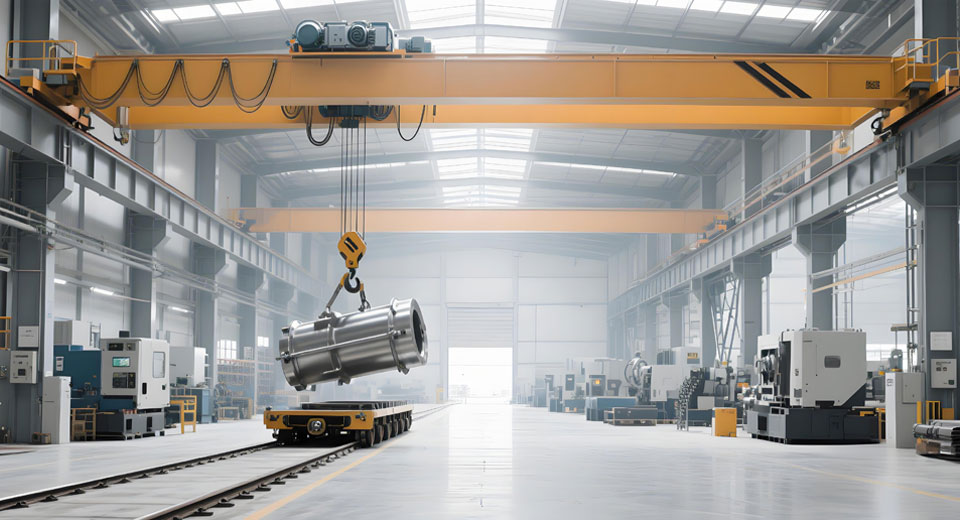
A bridge double girder crane typically consists of the following main parts:
The bridge frame consists of two main girders connected by cross beams. The dual-girder configuration enhances load distribution, provides greater rigidity, and supports larger spans, making it ideal for environments with high lifting demands.
The lifting mechanism typically includes a winch trolley or heavy-duty electric hoist, equipped with wire ropes, a drum, brake system, and hook group.
Compared with single-girder cranes, the lifting mechanism on double girders often allows:
Heavier capacities (5t–500t range in many industries)
Higher lifting heights, because the hoist sits between the girders
Better serviceability, due to larger maintenance platforms
The traveling mechanism combines motors, gearboxes, and wheels arranged at both ends of the bridge frame.
It provides:
Smooth long-travel motion
High accuracy positioning
Optional variable-frequency drive (VFD) for soft start/stop
Reduced structural stress on the runway beams
Modern double girder cranes adopt PLC-based electrical control, pendant control, radio remote, or cabin control. Intelligent functions include:
Anti-sway control
Automatic positioning
Load monitoring
Real-time safety feedback
These features significantly improve operational accuracy, process integration, and worker safety.
The electrical system includes power supply cables, motors, VFDs, circuit breakers, control cabinets, and safety interlocks. Advanced electrical configurations support:
Energy-saving operation
Smooth speed regulation
Overload and short-circuit protection
Reliable operation in harsh environments (dust, moisture, corrosive atmosphere)
The working principle of a bridge double girder crane primarily relies on the coordinated operation of the lifting, traveling, and bridge frame systems:
When the operator activates the lifting mechanism, the electric hoist raises the load using steel ropes or chains. As the hook rises, the load is lifted vertically.
Using the traveling mechanism, the bridge crane moves horizontally along the designated tracks. The operator controls the electric motor to move the crane freely within the workshop, warehouse, or factory to transport goods.
The two main girders of the bridge frame support the entire weight of the crane and ensure its stability during movement. The double girder design helps distribute the load, increasing the crane’s carrying capacity and stability.
The operator controls the lifting and traveling mechanisms through control panels or remote devices to precisely lift and move items. In modern cranes, intelligent control systems automatically adjust load, speed, and direction to further enhance operational efficiency.
Double girders are capable of handling medium to extremely heavy loads, commonly ranging from 10 tons to over 500 tons.
Their strong structure minimizes vibration and deformation, ensuring safety during full-load lifting.
The design allows:
Longer bridge spans
Higher lifting heights
Greater hook approach
This maximizes usable space in large workshops or warehouses.
Two girders provide excellent load distribution and structural stiffness, making the crane suitable for:
High-frequency lifting
Large-capacity reactions
Harsh working conditions
With modern PLC and VFD systems, users benefit from:
Smooth, precise speed control
Energy savings up to 30%
Automatic speed adjustment based on load
Predictive maintenance via smart monitoring
Double girder cranes support a high degree of customization:
Explosion-proof configurations
Insulation or heat-resistant solutions
Metallurgical-grade duty cycle
Additional platforms and walkways for easy maintenance
Optional cabin driver station or remote control
Double girders ensure better stability, even under heavy or dynamic loads. Combined with electrical safety systems, they significantly reduce operational risks.
With smoother motions and intelligent features, double girder cranes can:
Reduce cycle times
Improve production flow
Increase handling efficiency in busy environments
Made with high-strength steel, precise machining, and industrial-grade mechanisms, these cranes often last 20–30 years with proper maintenance.
Their strong structural integrity makes them ideal for:
High temperatures
Dust-filled plants
Corrosive marine or chemical settings
Heavy industrial vibration
Although initial investment is higher than single-girder cranes, the longer service life, lower maintenance demands, and higher output efficiency provide superior long-term ROI.
Due to their powerful load-bearing capacity and flexible operation, bridge double girder cranes are widely used in industries and locations where heavy lifting is required. Some typical application areas include:
In steel mills, bridge double girder cranes are used to transport steel billets, furnace materials, steel plates, and other heavy items. Their high load-bearing capacity and precise operation allow them to work stably even in high-temperature and harsh environments.
In shipbuilding, bridge double girder cranes are used to move large ship components and equipment. Since ship components are often large and heavy, bridge double girder cranes provide sufficient power and space to meet the demands of the shipbuilding industry.
In ports and freight yards, bridge double girder cranes are widely used for container handling, cargo loading, and unloading. They can efficiently operate on the dock to complete large cargo handling tasks.
On large construction sites, bridge double girder cranes are used to transport heavy construction materials and prefabricated components. They can cover large work areas and provide sufficient load-bearing capacity to handle various needs during construction.
In the warehousing and logistics industry, bridge double girder cranes are used to move heavy items and equipment. They can efficiently move goods in confined spaces, improving warehouse management efficiency.
With its strong load-bearing capacity, flexible operation, and wide range of applications, the bridge double girder crane is an ideal choice for lifting heavy objects in many industries.Contact us for more information about bridge cranes and customized solutions.
The key differences include load capacity, structural rigidity, and lifting height.
Double girder cranes:
Handle heavier loads
Offer higher hook lifts
Provide better stability
Support more accessories and walkways
Single girders are more cost-effective but limited to lighter-duty operations.
They can be operated by pendant control, wireless radio remote, or cabin control. Modern systems often include PLC control, anti-sway technology, VFD speed regulation, and intelligent monitoring for precise and safe operation.
They require strong runway beams, proper column spacing, sufficient building height, and stable power supply. For new buildings, crane requirements are usually incorporated into the structural design. For existing buildings, a feasibility evaluation is necessary.
We have 34 years of manufacturing experience and 12 years of export experience,business covers over 100 countries and regions worldwide, including Asia, Europe, America, Africa, and Oceania, forming a global product sales network.Received ISO system certification and CE product certification!Our main products include 6 series of nearly 100 varieties, including electric hoists, electric winches, gantry cranes, bridge cranes, marine cranes, and gantry cranes.
E-mail: karida@weiyinglift.com
Website: www.wycrane.com