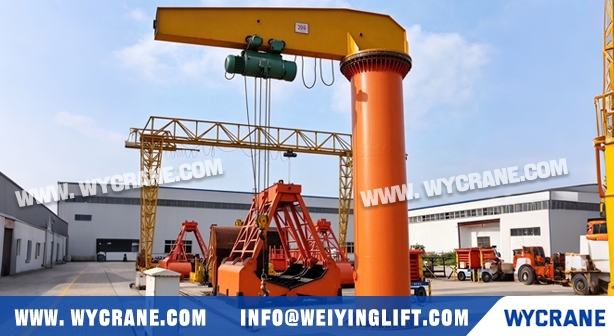
When buyers compare
jib cranes, the conversation almost always starts with the same three numbers: capacity, span, and lifting height. These are easy to compare across quotes. But the component that determines whether your crane runs for ten years or ten weeks is usually the one nobody asks about — the
power supply and cable management system.
A jib crane is a rotating machine. Every time the boom swings, every cable attached to it must move too. If the power supply is poorly designed, cables twist, chafe against steel edges, snap, or tangle around the mast. The results are predictable: unplanned downtime, expensive cable replacements, tripped breakers, and in the worst case, a live wire hanging over your workers’ heads.
This guide covers what purchasing engineers and facility managers actually need to know: how power reaches a rotating jib crane, how cable tangling is prevented, which components matter, and exactly which questions to ask your supplier before signing a purchase order.
How Power Reaches a Rotating Jib Crane
There are four common power supply configurations, and the right one depends on your installation environment, rotation requirements, and budget.
1. Bottom Entry Power Supply
With bottom entry, the main power cable comes up from the floor (or through the foundation for a floor-mounted column crane) and enters the crane at the base of the mast. From there, it runs up inside or alongside the column and out to the hoist.
This is the simplest and most economical arrangement. Cable runs are short, installation is straightforward, and maintenance access is easy. Bottom entry is the default choice for floor-mounted pillar jib cranes in workshops, machine shops, and loading areas where power can be supplied from the floor or a nearby pedestal.
2. Top Entry Power Supply
For wall-mounted jib cranes, or floor-mounted units installed in buildings with existing overhead power infrastructure (such as a busbar system feeding overhead cranes), power enters at the top of the column. The cable runs down the column to the hoist trolley.
Top entry avoids bringing power up from the floor, which can be valuable where floor conduits would interfere with machinery, forklifts, or drainage. The trade-off is a slightly longer cable path and a need for access equipment (a lift or scaffolding) during installation and maintenance.
3. Conductor Bar and Festoon Systems on the Boom
The arrangements above get power to the crane. But the hoist also travels along the boom, and that horizontal travel needs its own cable management. Two systems dominate:
-
Conductor bars — copper or aluminum busbars mounted along the boom, with current collectors riding on the hoist trolley. Durable, compact, and suited to long booms and heavy duty cycles.
-
Festoon systems — a looped cable supported by trolleys running on a track under the boom. Cheaper upfront and flexible, but the hanging loops consume headroom and the cables are more exposed to damage.
For short booms with infrequent trolley travel, a simple hanging power cord with a service loop may suffice. For anything heavier, specify a conductor bar or festoon track explicitly — don’t assume your supplier will include one by default.
4. Slip Rings for Continuous Rotation
All the arrangements so far assume the crane rotates within a limited angle. But what if your process requires continuous or near-continuous rotation? This is where slip rings (collector rings) come in.
A slip ring is an electromechanical device installed at the rotating joint of the column. It transfers electrical power — and optionally control and signal circuits — from the stationary column to the rotating upper structure through conductive rings and spring-loaded brushes. This allows 360° unrestricted rotation without any twisting of the main power cable.
Slip rings are specified by the number of rings (power phases plus neutrals/grounds, plus control circuits, plus any signal circuits such as encoder feedback for variable frequency drives) and their current capacity. If your application involves frequent full rotations — such as feeding a production line, loading/unloading rotating equipment, or shared use between adjacent workstations — a slip ring is not optional; it is essential.
How to Prevent Cable Tangling
Cable tangling is the single most common jib crane failure, and it is almost always a design or specification problem, not a user error. Here is how it is prevented.
Rotation Angle Limits and Mechanical Stops
The simplest solution is to limit how far the crane can rotate. Most standard jib cranes without slip rings are equipped with rotation angle limiters and buffer stops, typically limiting travel to ±180° or ±360°. Within this range, a properly sized cable loop hangs in the mast area without twisting beyond its design limit.
Rotation limits work well for low-to-medium duty applications: occasional positioning of loads, single workstation coverage, or use between two adjacent work areas. They fail when operators habitually swing the crane against the stops, which fatigues the cable over time. If your process requires constant rotation, limiters are a false economy — buy a slip ring.
Cable Length and Service Loop Design
Even within limited rotation, cables need service loops — extra length that hangs in a smooth loop and absorbs the swing motion. Key design rules:
-
Size the loop for the full rotation arc, not the average working angle.
-
Respect the minimum bending radius. Standard flexible cables typically require a bend radius of 6–8× the cable’s outer diameter; high-flex drag chain cables can go down to 5× or less. Bending tighter than rated kinks conductors and cracks insulation.
-
Never support the loop from a single point. Use a hanging bracket, a swivel hook, or a counterweight arrangement so the loop hangs vertically and moves with rotation.
Cable Routing, Guides, and Protection
Where the cable changes direction — out of the column, along the boom, down to the hoist — it must be protected from chafing against steel edges:
-
Use cable clamps and grommets at every penetration point.
-
Specify drag chains (energy chains) where the cable moves frequently, especially on the trolley travel path.
-
Use festoon trolleys or cable reels for longer horizontal runs.
-
Protect outdoor or washdown installations with IP-rated enclosures and UV/oil-resistant cable jackets.
One frequently missed detail: the power entry point location relative to the rotation center determines the natural cable path. A cable entering the column off-center will bias the hanging loop to one side, causing uneven wear. Good suppliers design the entry point and internal routing together.
Slip Ring vs. Rotation Limits: A Quick Comparison
| Factor | Rotation Limits | Slip Ring |
| Upfront cost | Low | Higher |
| Rotation | Limited (±180° typical) | Full 360° continuous |
| Maintenance | Minimal (cable inspection) | Periodic brush cleaning/replacement |
| Reliability at high duty | Poor — cable fatigue | Excellent |
| Best for | Light/medium duty, fixed workstations | High-frequency rotation, production lines |
Rule of thumb: if the crane will complete more than a few full rotations per hour, every working day, choose a slip ring.
Key Components to Specify on Your RFQ
When requesting quotes, put these items in writing so every supplier prices the same scope:
-
Slip ring: number of circuits (power + control + signal), current rating per ring, and IP rating (IP54 minimum indoors; IP65 for harsh environments).
-
Cable type: For moving applications, specify high-flex drag chain cable (such as YFFB-type flat cable or equivalent), not ordinary rubber-sheathed construction cable. For VFD-driven hoists, specify EMC-shielded motor supply cable.
-
Rotation angle: state the maximum continuous rotation your process requires, and whether 360° rotation is a must-have or a nice-to-have.
-
Control voltage: typically 24V or 48V control circuits for pendant or radio control; confirm compatibility with your facility standards.
-
Grounding: a dedicated grounding path through the slip ring (if fitted) and across all rotating joints — never rely on the slewing bearing for grounding.
-
Outdoor use: UV-resistant cable jackets, sealed enclosures, and appropriate corrosion protection (e.g., galvanization or marine-grade coating).
Questions to Ask Your Supplier Before You Buy
-
What is the maximum continuous rotation angle, and is a slip ring included as standard or an option?
-
Is the festoon/conductor bar system for the trolley included in the quoted price? Many quotes exclude it.
-
What cable type and brand is supplied? Ask for the datasheet — “festoon cable” can mean very different quality levels.
-
What are the replacement costs and lead times for slip ring brushes and the hoist cable?
-
Which certifications does the electrical system carry — CE, ISO 9001 — and does the crane comply with your local electrical code (NEC, IEC, etc.)?
-
Is a cable replacement procedure documented? A crane that takes two days to re-cable costs far more over its life than one designed for quick swaps.
Common Failures and a Simple Maintenance Schedule
Even well-designed systems need routine attention. The early warning signs of cable trouble are intermittent power loss during rotation, visible cable flattening or cracking, and burned marks near slip ring brushes.
| Interval | Inspection Task |
| Daily (by operator) | Visual check: no cable kinks, hanging loop moves freely, no exposed conductors |
| Monthly | Check festoon trolleys roll freely; verify clamps and grommets tight |
| Quarterly | Clean slip ring brush dust; measure brush wear; check rotation limit stops for looseness |
| Annually | Insulation resistance test; replace cables showing jacket cracking; verify grounding continuity |
Conclusion: Treat the Power System Like the Capacity Rating
A jib crane’s capacity and span determine what it can lift; its power supply and cable management determine whether it lifts at all. Match the system to your actual duty cycle: rotation limits and a festoon loop for light, occasional use; a slip ring and conductor bar for continuous, production-critical rotation. And put the scope in writing on your RFQ — it is far cheaper to specify the right system before delivery than to retrofit it after the cable wraps itself around the mast.
FAQ
1. How do I stop my jib crane cables from tangling? +
There are three main methods: (1) install rotation angle limiters so the crane physically cannot over-rotate; (2) use a slip ring for true 360° continuous rotation; and (3) ensure the service loop (extra cable length) is correctly sized, hangs freely, and never bends tighter than the cable’s minimum bend radius. In practice, a combination of all three — plus proper cable guides and clamps — is the most reliable solution.
2. What IP rating should a jib crane electrical system have? +
For standard indoor industrial use, IP54 is the practical minimum. For dusty, humid, or outdoor environments, specify IP65 or higher, especially for the slip ring enclosure and any junction boxes. Washdown or corrosive environments (food processing, marine) may require IP67 plus stainless steel fittings.
3. How many degrees can a jib crane rotate without a slip ring? +
Most jib cranes without a slip ring are limited to ±180° or ±360° total rotation, enforced by mechanical stops. Beyond this range, the power cable would twist and eventually fail. If your application requires continuous rotation — more than a few full revolutions per hour on a regular basis — a slip ring is strongly recommended.
About us
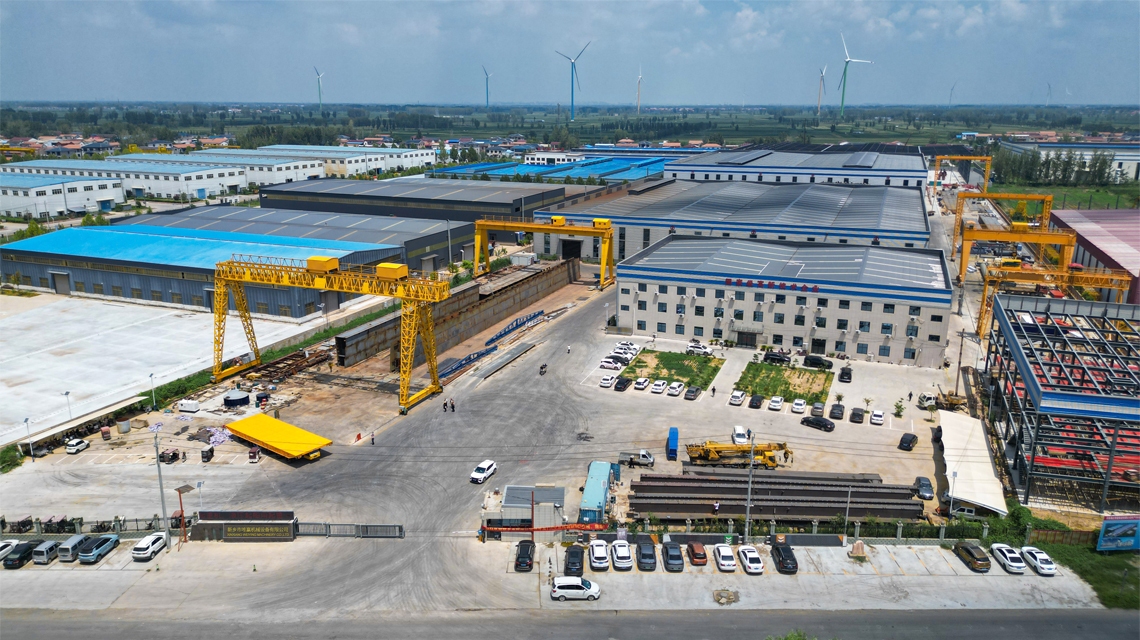
With 34 years of manufacturing experience and 12 years of export expertise, we have built a dual advantage of professional qualifications and a global presence. Our business covers more than 100 countries and regions across Asia, Europe, the Americas, Africa, and Oceania. We are certified under the ISO management system and hold CE product certifications. Our main product lines include six major series—electric hoists, electric winches, gantry cranes, bridge cranes, marine cranes, and portal cranes—comprising nearly 100 different models.
If you want to learn more, please contact us.
E-mail address: info@weiyinglift.com
Website:www.wycrane.com