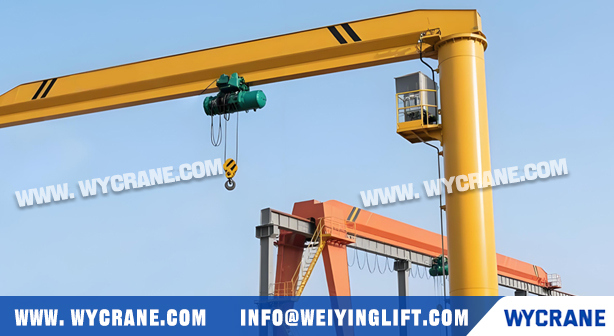
How to Reduce Jib Crane Installation and Maintenance Costs
October 29 , 2026
Ask most buyers what a jib crane costs, and they will quote the supplier’s price list. But the purchase price typically accounts for only 20–30% of the machine’s true lifetime cost. The rest is hidden in installation labor, foundations, energy consumption, spare parts, maintenance hours, and — the most expensive line item of all — unplanned downtime.
The good news: most of these costs are decided long before the crane arrives on site. Design choices, installation planning, and maintenance strategy lock in the majority of your total cost of ownership (TCO) up front. This guide covers practical, proven methods to reduce both ends of that equation, without cutting corners on safety or compliance.
Phase 1: Design and Selection — Where the Money Is Really Saved
Right-Size the Crane, Not the Brochure
The most expensive sentence in procurement is “let’s add margin, just in case.” A crane specified one capacity class or one duty class above actual need carries a cascade of hidden costs: a larger hoist, heavier structural steel, a more substantial foundation, bigger electrical supply, and more demanding maintenance requirements.
Match the machine to the real job. Define your heaviest load including rigging, estimate true lifts per hour, and select the corresponding FEM/ISO duty class. If future growth is genuinely planned, size for it — but do it deliberately, not by default. Overdesign you never use is not insurance; it is expense.
Standardize Your Fleet
If you operate multiple cranes in one facility, standardizing on a single brand and model family is one of the highest-ROI decisions available. Shared spare parts, one set of maintenance documentation, and technicians who know one system instead of five will cut your parts inventory and training budget measurably. It also strengthens your negotiating position with the supplier.
Choose the Mounting Method With Installation Cost in Mind
The foundation is often the most underestimated installation expense:
Foundation-mounted column cranes require excavation, rebar, concrete, curing time, and precision anchor bolt setting. Budget days, not hours.
Base-plate cranes with chemical or expansion anchors bolt directly to an existing engineered slab — dramatically cheaper and faster, provided the slab genuinely meets the load and pull-out requirements. Have a structural engineer verify it.
Wall-mounted cranes transfer loads to building steel, eliminating foundations entirely — but demand a verified wall structure and can complicate future building modifications.
Also plan power provision during the design phase. Running a dedicated circuit during a planned renovation costs a fraction of cutting and patching concrete afterward.
Phase 2: Cutting Installation Costs — Six Practical Methods
1. Specify Bolted, Pre-Assembled Construction
Cranes delivered pre-assembled with bolted connections install in hours; field-welded or fully knocked-down units consume days of labor plus welding inspection. When comparing quotes, ask each supplier for their estimated installation man-hours — the cheapest crane can become the most expensive installed one.
2. Plan Rigging and Site Access Before Delivery Day
Measure every door, corridor, and ceiling on the delivery route. Confirm whether a forklift, existing overhead crane, or rented mobile crane will place the unit, and book it for the same window. A crane that arrives and cannot be moved to its position triggers return freight, storage fees, and a second mobilization — a four-figure mistake that pure paperwork prevents.
3. Choose the Right Installer Deliberately
You generally have three options: the supplier’s installation team, a third-party rigging contractor, or your own maintenance crew. Self-installation looks cheapest on paper, but check your local regulations first — some jurisdictions require certified installers for load-handling equipment, and insurance or warranty terms may depend on it. Where self-install is permitted and your team is competent, supplier-supervised installation (you do the work, they verify) is an effective middle ground.
4. Order Early Enough to Avoid Premiums
Standard jib cranes are often stocked; modified or large units are not. A rushed order converts standard freight into air freight and standard production into overtime production. Plan purchasing around real installation windows, and schedule installation during your maintenance shutdown rather than mid-production.
5. Get Precision Right the First Time
Anchor bolt location, column verticality, and boom alignment are exponentially cheaper to correct during installation than after commissioning. A plumb error discovered during assembly is an afternoon’s work; the same error discovered after months of operation means worn slew bearings, uneven wheel loads, and re-machining. Use laser levels, follow the torque sequence, and complete the acceptance checklist before the installers leave site.
6. Coordinate Power and Controls Up Front
Confirm the power supply arrangement — bottom entry, top entry, or slip ring — matches what your electrician will actually deliver, and terminate control wiring at labeled junction points. Electricians discovering undocumented wiring on installation day bill by the hour for detective work.
Phase 3: Cutting Maintenance Costs — Six Practical Methods
1. Run a Written Preventive Maintenance Program
Unplanned breakdowns cost multiples of planned work: emergency call-out rates, expedited parts, production loss, and potential secondary damage. A simple schedule — daily operator checks, monthly inspections, annual professional service — converts chaos into planned, budgeted activity. One planned hour of maintenance routinely prevents a full shift of downtime.
2. Manage Wear Parts Strategically
Maintain a short list of your crane’s critical wear parts: load chain or wire rope, brake linings, contactors, pendant cable, and slip ring brushes (if fitted). Keep one set of genuinely critical items on site; for the rest, confirm your supplier holds local stock. The cheapest spare part is the one you never need because the crane keeps running — the most expensive is the one on a three-week boat while your line is down.
3. Take Lubrication Seriously
Inadequate or contaminated lubrication is among the leading causes of gearbox and bearing failure. Follow the manufacturer’s lubrication chart strictly, use specified grades, and consider automatic lubrication on high-duty applications where access is difficult. A grease gun costs little; a replacement slew bearing costs a great deal.
4. Train Your Operators
A significant share of chain, rope, and hook damage comes from avoidable operator behavior: side pulling, dragging loads, shock loading, and riding the hoist. Structured operator training is the cheapest risk investment in this entire article — a half-day session pays for itself the first time someone doesn’t wrap a sling around a sharp edge.
5. Use the Diagnostics You Already Own
Modern hoists and VFDs log fault history, operating hours, and overload events. Reviewing this data quarterly reveals deteriorating trends long before failure — a brake drawing increasing current, a motor running hot, contactor wear. Where remote diagnostics are offered, they can eliminate entire site visits for troubleshooting.
6. Control the Environment
Dust abatement, drip shields above outdoor units, heat shielding near furnaces, and washdown-rated enclosures cost hundreds — compared with the thousands they save in premature failures. If your environment is harsh, spending a little on protection beats spending a lot on repair.
Five “Savings” That Actually Cost You More
Buying the cheapest crane. Higher failure rates, shorter component life, and unavailable parts routinely erase the initial saving within the first years of service.
Skipping preventive maintenance. Deferred small problems compound into major overhauls — a worn brake pad is a $50 part; the dropped load it causes is not.
Non-genuine spare parts. Pattern parts may fit, but unknown metallurgy in chains, ropes, and hooks is a gamble with load-bearing safety. They can also void your warranty.
Unqualified repairs. Load-handling equipment is legally and morally different from ordinary machinery. Improper repairs create liability that dwarfs any invoice saved.
Comparing single repair quotes only. A cheaper visit with a ten-day response time costs more than a premium visit with next-day response, once downtime is priced in.
Conclusion
The cheapest jib crane to own is usually not the cheapest to buy. Roughly 70% of lifetime cost is locked in during design and installation — capacity choices, mounting method, precision of assembly, and the maintenance regime you commit to on day one. Right-size the machine, install it once and correctly, protect it from its environment, and maintain it on schedule. Do these things, and both your installation invoices and your maintenance budget will shrink — safely, and for the life of the crane.
FAQ
Unplanned downtime. Emergency repairs carry premium labor rates, expedited freight, and lost production — typically several times the cost of the same repair done preventively. This is why maintenance strategy matters more than purchase price.
At minimum: one load chain or wire rope set, brake components, contactors, and pendant cable. These are the items whose failure stops the crane outright. Confirm everything else is available from local supplier stock.
Three habits cover most of it: operate within rated capacity (no side pulling or shock loading), keep it lubricated per schedule, and fix small defects during planned maintenance rather than letting them accumulate.
About us
With 34 years of manufacturing experience and 12 years of export expertise, we have built a dual advantage of professional qualifications and a global presence. Our business covers more than 100 countries and regions across Asia, Europe, the Americas, Africa, and Oceania. We are certified under the ISO management system and hold CE product certifications. Our main product lines include six major series—electric hoists, electric winches, gantry cranes, bridge cranes, marine cranes, and portal cranes—comprising nearly 100 different models.