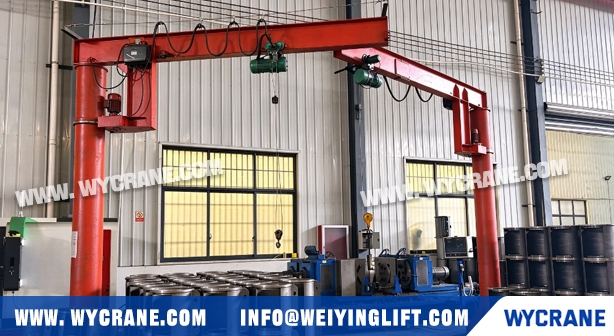
Buyers spend weeks comparing
jib crane columns, boom lengths, and rotation systems — then pick the
hoist in five minutes from a price list. That is backwards. The crane structure determines what the machine
can lift, but the hoist determines whether it lifts safely, smoothly, and for years without a breakdown.
A mismatched hoist costs far more than its purchase price: overloaded motors burn out, chains and ropes fail early, and under-specced brakes turn a routine lift into a dropped load. This guide walks through the main hoist types for jib cranes, the technical factors that actually matter, the mistakes that buyers repeat most often, and the situations where a complete crane-and-hoist package makes more sense than sourcing components separately.
Types of Hoisting Devices for Jib Cranes
Electric Wire Rope Hoist
Wire rope hoists lift on a drum-wound steel cable. They offer fast lifting speeds, long lifting heights, and smooth operation, and they dominate in capacities above roughly 2 tons. Modern units are compact, often with a low-headroom configuration that keeps the hook high — valuable on jib cranes where boom clearance is limited. Expect to pay more upfront, but get longer service life in demanding duty cycles.
Electric Chain Hoist
Chain hoists lift using a load chain over a pocket wheel. They are lighter, more compact, and cheaper than wire rope units in the 0.5–5 ton range, which covers the vast majority of workshop jib cranes. Double-fall chain configurations (chain reeved in two parts) double capacity while halving speed. For general-purpose indoor lifting, a quality electric chain hoist is the default choice.
Manual Chain Hoist and Lever Hoist
No electricity required, minimal cost, total simplicity. Manual hoists suit very low-frequency applications — a few lifts per day, light loads, or sites without reliable power. The trade-off is obvious: slow operation and real operator fatigue. Never pair a manual hoist with a high-duty jib crane; the bottleneck will frustrate users into unsafe corner-cutting.
Pneumatic Hoist
Powered by compressed air, pneumatic hoists are inherently explosion-proof, offer stepless speed control, and tolerate wet or dirty environments. They are the right choice for paint shops, chemical plants, and offshore or washdown areas — anywhere sparks from electric motors are unacceptable. You will need a properly sized compressed-air supply, which is an infrastructure cost often forgotten.
Specialized Hoists
-
Explosion-proof hoists: Ex-rated with ATEX or IECEx certification for Zone 1/2 (gas) and Zone 21/22 (dust) environments.
-
Cleanroom hoists: Stainless-steel enclosures, sealed gears, and non-shedding lubricants for food, pharmaceutical, and electronics production.
-
High-temperature / metallurgical hoists: Heat-shielded motors and brakes for foundries and casting operations.
Key Selection Factors — and the Mistakes That Follow Them
Each factor below includes the error buyers make most often. Read both parts.
1. Rated Capacity and Safety Margin
Size the hoist for the heaviest load plus the weight of all handling equipment below the hook — slings, grabs, magnets, vacuum lifters. As a rule, keep at least 10–20% margin above your real maximum working load to protect the mechanism and accommodate future growth.
⚠️ Common mistake: Buying exactly at the line. A buyer specs a 2-ton hoist because their largest part weighs 1,950 kg, then adds a 100 kg lifting beam and runs the machine at or above rated capacity every day. Motor overheating and brake wear follow within months. The overload limiter will also trip constantly, annoying operators into bypassing it.
2. Lifting Height and Headroom
Calculate the full vertical envelope: distance from the boom down to the lowest required hook position, plus the height of the hoist body and hook block themselves. On a jib crane, boom height is often constrained by building steel or existing cranes, so headroom is usually the binding constraint.
⚠️ Common mistake: Ignoring the hoist’s own height. The load calculation fits, the boom clears every obstacle — and on installation day the hook only reaches chest height because a standard-headroom hoist body consumed 800 mm of the available drop. Specify a low-headroom hoist whenever every centimeter under the boom matters.
3. Duty Class, Lifting Speed, and Duty Cycle
Match the hoist’s duty classification (FEM/ISO groups, roughly M3–M8) to your actual usage: starts per hour, load spectrum, and operating time. Speed matters too — single-speed for occasional lifts, two-speed for positioning work, and variable frequency drives (VFD) where precise, soft handling of fragile or expensive loads justifies the cost.
⚠️ Common mistake: Underrating the duty class. A light-duty (M3) chain hoist pressed into 40 lifts-per-hour production service will see its motor insulation and contactors fail in a fraction of their design life. Upgrading a class is far cheaper than replacing a burnt motor — and the downtime it causes.
4. Power Supply and Controls
Confirm voltage, phase, and frequency against your facility (380V/3Ph/50Hz and 460V/3Ph/60Hz are common standards — they are not interchangeable). Choose between a push-button pendant and a radio remote; low-voltage (24–48V) control circuits are strongly preferred for operator safety.
⚠️ Common mistake: Assuming compatibility. A hoist wired for 460V/60Hz run on a 380V/50Hz supply loses significant speed and power, and heating rises. Also verify control voltage: a 110V pendant on a wet shop floor is a hazard, not a feature.
5. Trolley Type and Boom Interface
The hoist must ride the boom. Options: a plain (hand-pushed) trolley, a geared trolley, or a motorized trolley. Hoists with an integrated traveling trolley are compact and simple; separate trolleys suit larger wire rope units.
⚠️ Common mistake: Electric hoist, manual trolley. The crane lifts 3 tons electrically — then an operator must physically shove that 3-ton load along the boom. On any boom longer than ~3 meters or any frequent-repositioning application, specify a motorized trolley. Also confirm the trolley’s adjustable width range actually fits your boom flange dimensions.
6. Environment and Protection Rating
Indoor, clean, dry workshop? IP54 is adequate. Dusty, humid, outdoor, or washdown environments demand IP65 and appropriate cable and enclosure sealing. Explosive atmospheres require Ex-rated hoists matched to the zone classification.
⚠️ Common mistake: Indoor hoist outdoors. A standard hoist in an unprotected yard suffers water ingress in the brake and gearbox within one season. UV degradation cracks pendant cables. If any part of the travel path is outside, say so on the RFQ.
7. Certification and Compliance
Require CE marking (or ANSI/ASME B30 compliance for the US market), FEM/ISO duty documentation, and certificates traceable to the actual serial number. This is your proof for insurers, inspectors, and liability purposes.
⚠️ Common mistake: No-name hoists without documentation. The unit lifts fine on day one — and cannot pass a statutory inspection, leaves you exposed after an accident, and leaves you hunting for parts that do not exist. Certification is not paperwork; it is risk transfer.
When Should You Buy a Complete Jib Crane and Hoist Package?
The Package Usually Wins When:
-
This is your first purchase or you lack in-house rigging expertise — one supplier carries single-point responsibility for design, warranty, commissioning, and documentation.
-
Your application is standard — common capacities (0.5–5 t), standard spans, normal duty. Package systems are usually stocked and ship fast.
-
Lead time matters. Matched packages avoid the integration delays of sourcing a hoist from one vendor and steel from another.
Source Components Separately When:
-
The environment is special — explosion-proof, cleanroom, or extreme-temperature duty usually points to a specialist hoist brand your crane supplier may not carry.
-
You have an incumbent hoist brand standard (CM, Demag, Konecranes, Yale, etc.) for fleet-wide spare-part commonality.
-
It is a retrofit — replacing a failed hoist on an existing boom demands exact interface matching with the old structure, which a crane OEM is rarely best placed to handle.
-
You genuinely want to own the integration risk to capture a lower price.
If You Buy the Package, Verify in Writing:
-
The hoist brand and exact model in the quotation — “2-ton electric hoist, brand TBD” is a red flag.
-
Whether the price includes the trolley, pendant or radio remote, limit switches, and mounting hardware.
-
The warranty scope: whole system, or separate (and shorter) terms for the hoist?
-
Spare parts availability: chain/rope, brake parts, contactors — in stock or on a slow boat?
Quick Selection Checklist
Take this to every supplier conversation:
-
[ ] Max load + rigging weight, with 10–20% margin
-
[ ] Required hook travel and available headroom (low-headroom needed?)
-
[ ] Estimated lifts per hour → required duty class
-
[ ] Supply voltage/frequency and preferred control method
-
[ ] Trolley type: plain, geared, or motorized — flange width confirmed
-
[ ] Environment: indoor/outdoor, temperature, dust, washdown, explosive zone
-
[ ] Required certifications (CE, ATEX/IECEx, ANSI/ASME, local code)
-
[ ] Package scope confirmed in writing (brand, trolley, controls, warranty)
Conclusion
The jib crane column and boom are visible in every brochure photo; the hoist does the actual work in anonymity. Give it equal attention: size capacity with margin, respect duty class, check headroom before you check price, and decide deliberately whether a package or a component build fits your situation. Fill in the checklist, demand everything in writing, and the hoist will be the most reliable part of the machine — instead of its most frequent failure.
FAQ
1. What type of hoist is best for a jib crane? +
For most indoor applications under 5 tons, an electric chain hoist offers the best balance of cost, compactness, and reliability. Above 2–3 tons with frequent lifting or long hook travel, a wire rope hoist delivers better speed and duty life. Manual hoists only suit very light, infrequent use.
2. What is the difference between a chain hoist and a wire rope hoist? +
A chain hoist lifts with a load chain over a pocket wheel; a wire rope hoist winds steel cable onto a drum. Chain hoists are cheaper and more compact at small capacities; wire rope hoists are faster, offer longer lifting heights, and handle heavy duty cycles better.
3. Can I use any hoist on any jib crane? +
Not without verification. You must match capacity, headroom, trolley flange width to the boom, power supply, and duty class. Mixing brands also creates interface and warranty complications, which is why complete packages are recommended for first-time buyers.
About us
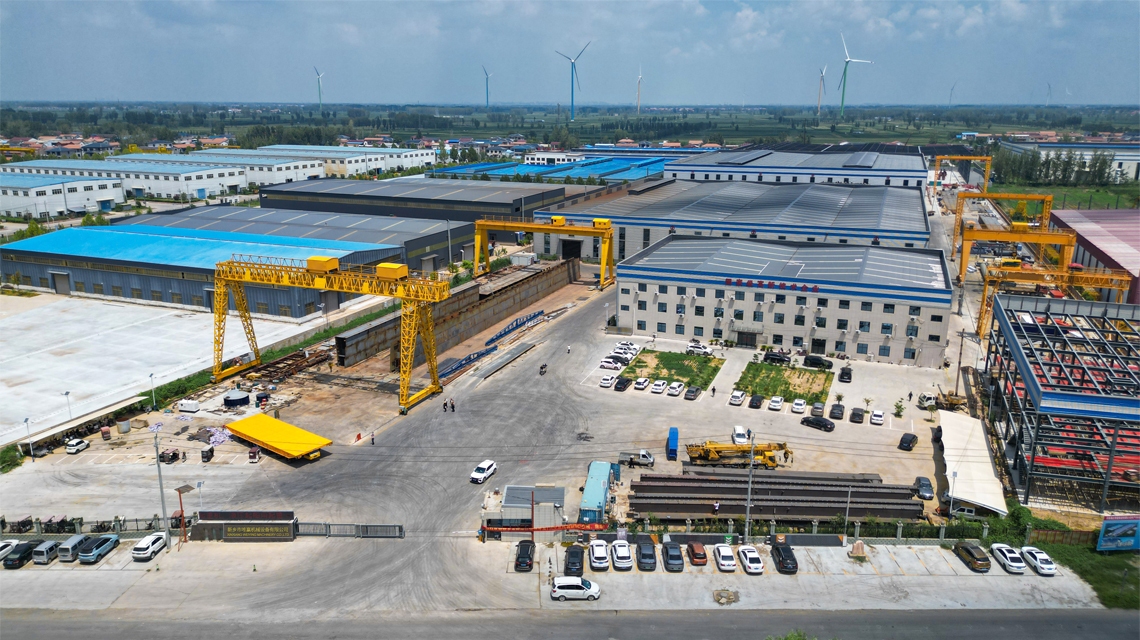
With 34 years of manufacturing experience and 12 years of export expertise, we have built a dual advantage of professional qualifications and a global presence. Our business covers more than 100 countries and regions across Asia, Europe, the Americas, Africa, and Oceania. We are certified under the ISO management system and hold CE product certifications. Our main product lines include six major series—electric hoists, electric winches, gantry cranes, bridge cranes, marine cranes, and portal cranes—comprising nearly 100 different models.
If you want to learn more, please contact us.
E-mail address: info@weiyinglift.com
Website:www.wycrane.com